

Impressionism Art Dark – Unique Appeal for Collectors
Sourcing artwork that combines historic depth with striking emotional impact is a challenge every dedicated collector encounters, especially in the nuanced field of dark-themed Impressionism. The origins of this movement trace to a turbulent France, where artists such as Claude Monet and Edgar Degas infused their work with somber tones and shadow, responding directly to societal trauma caused by events like the Franco-Prussian War. Exploring Dark Impressionism’s complex atmosphere offers collectors the opportunity to connect with rare pieces where technique and context elevate both aesthetic and investment value.
Table of Contents
- Defining Dark Impressionism and Its Origins
- Core Techniques Used in Dark Impressionism
- Notable Artists and Iconic Artworks
- Collector Value and Investment Insights
- Common Pitfalls in Authenticating Works
Key Takeaways
| Point | Details |
|---|---|
| Emergence of Dark Impressionism | This movement developed during the 1860s and 1870s in France, reflecting societal trauma from historical upheavals like the Franco-Prussian War. |
| Distinct Techniques | Artists employed unique methods such as layered brushwork and chiaroscuro to create emotional depth, using somber colors to reflect darker themes. |
| Notable Artists | Figures like Claude Monet and Edgar Degas contributed significantly to this evolution, utilizing their mastery to convey psychological complexities in their works. |
| Investment Considerations | Authenticity and provenance are crucial factors for collectors, as market prices can vary dramatically based on documented histories and artist reputations. |
Defining Dark Impressionism and Its Origins
Dark Impressionism emerged as a distinct artistic response to specific historical circumstances. Rather than just a stylistic preference, it reflects a deeper engagement with the turbulent world around the artists who created it.
The movement took shape during the 1860s and 1870s in France, a period marked by profound social upheaval. The Franco-Prussian War and the Paris Commune left scars on French society that artists could not ignore. Societal trauma influenced the darker tone of some Impressionist works, diverging sharply from the bright, leisurely scenes typically associated with the movement.
What sets Dark Impressionism apart from traditional Impressionism?
- Somber color palettes replacing the lighter, more vibrant hues
- Shadow and moodier atmospheres capturing emotional weight rather than fleeting light
- Engagement with human suffering and societal realities instead of escapist beauty
- Dramatic compositions reflecting instability and uncertainty
Traditional Impressionism emphasized capturing light and momentary impressions through bright, optimistic scenes. Dark Impressionism maintained the movement’s core technique of capturing fleeting moments, but channeled it toward depicting darker emotions and heavier subject matter. These artists didn’t abandon Impressionist principles—they expanded them.
To clarify the distinctions between traditional Impressionism and Dark Impressionism, here’s a concise comparison:
| Aspect | Impressionism | Dark Impressionism |
|---|---|---|
| Typical Themes | Leisure, light, landscapes | Mood, trauma, introspection |
| Color Palette | Bright, pastel, vibrant | Somber, muted, earthy |
| Light Treatment | Sunlit, outdoor, direct | Twilight, shadow, interior |
| Emotional Impact | Optimism, spontaneity | Contemplation, melancholy |
| Societal Engagement | Escapist, idealized moments | Response to real-world events |
The origins trace back to how artists processed collective trauma. Following widespread social unrest, painters sought to reflect the complexity of their times rather than provide comforting retreats into leisure and landscape. This wasn’t a conscious rebellion against Impressionism itself, but rather a natural evolution responding to historical necessity.
Dark Impressionism proves that artistic movements aren’t monolithic—they shift and adapt as society itself transforms.
For collectors, understanding these origins matters significantly. The historical context explains why certain works possess that distinctive emotional weight. When you examine a dark Impressionist piece, you’re looking at an artist’s direct response to living through unprecedented instability and change.
Pro tip: When evaluating dark Impressionist works for your collection, research the specific historical period and location where each piece was created—this context transforms your appreciation from surface-level visual observation into understanding the artist’s intentional commentary on their turbulent world.
Core Techniques Used in Dark Impressionism
Dark Impressionist artists employed specific technical methods to create their distinctive visual impact. These techniques built upon traditional Impressionist approaches while deliberately shifting toward emotional intensity and psychological depth.
The foundation of dark Impressionism rests on masterful use of color and light manipulation. Rather than celebrating bright sunlight, these artists harnessed shadow and muted tones to establish mood. Deep blues, grays, blacks, and earth tones replaced the pastel palettes favored by their lighter-focused contemporaries. This wasn’t about abandoning color theory—it was about weaponizing it differently.
Key technical approaches include:
- Layered brushwork applying paint in deliberate, visible strokes to create textural depth
- Chiaroscuro principles emphasizing dramatic contrast between light and shadow
- Reduced color saturation intensifying emotional weight through restraint
- Impasto technique building paint thickness for dimensional, tactile surfaces
- Strategic composition placing subjects off-center to suggest tension and unease
Light treatment distinguishes dark Impressionism from its brighter counterpart. Rather than painting direct sunlight, artists captured diffused, filtered, or disappearing light. Twilight scenes, overcast skies, and interior shadows became primary subjects. This approach allowed emotional depth in art to resonate more powerfully through visual means.
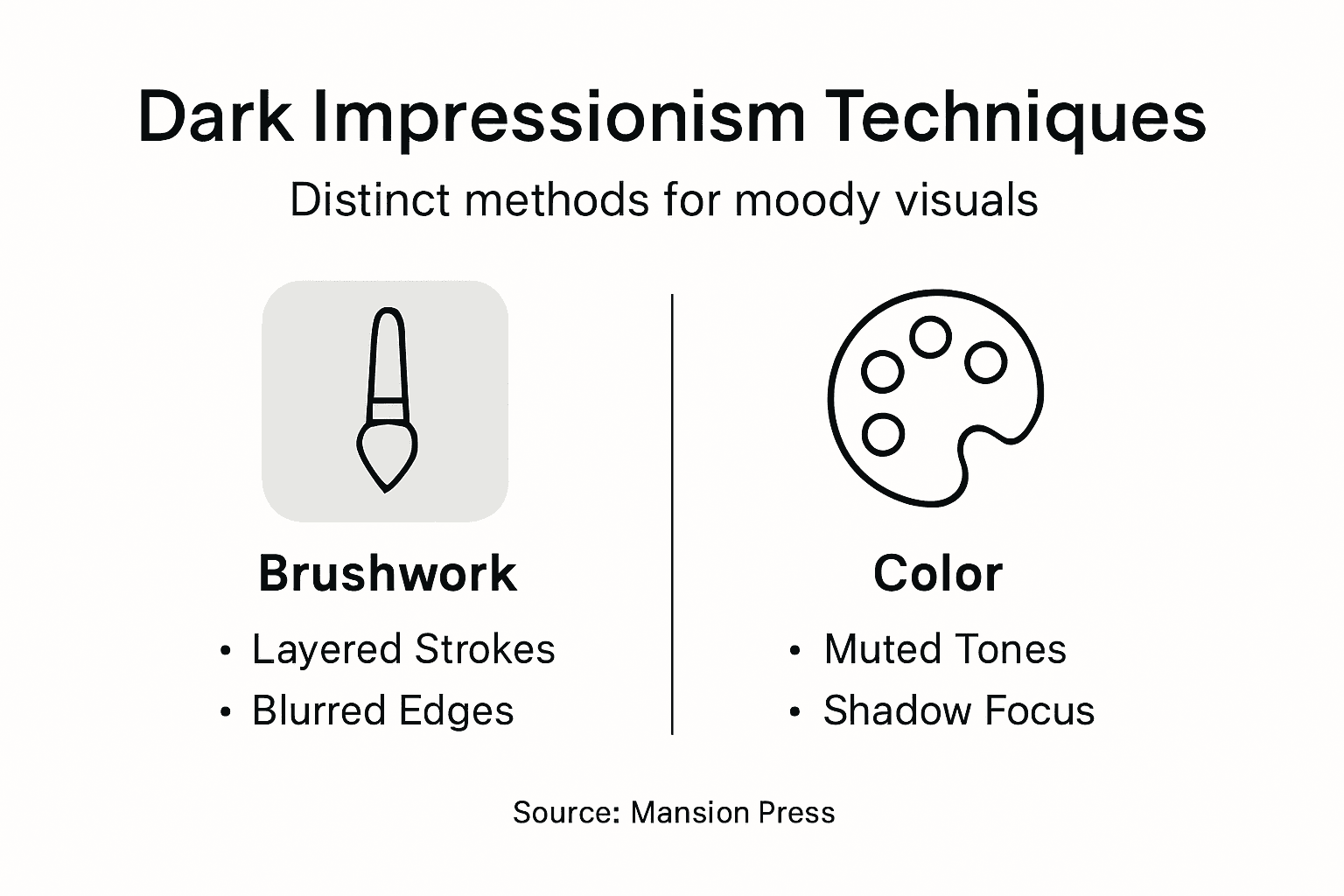
Brushwork remained distinctly Impressionist—loose, visible, and energetic. However, the gestural quality now conveyed anxiety, contemplation, or melancholy rather than spontaneous joy. Every stroke carried intentional psychological weight.
Atmospheric perspective received unique treatment in dark works. Artists created spatial depth not through traditional linear perspective alone, but through layered shadows and graduated tones. Foreground elements often emerged from darkness, creating a sense of emerging consciousness or revelation.
Dark Impressionists proved that technical mastery serves emotional storytelling—the method becomes inseparable from meaning.
These techniques required exceptional skill. Creating visual interest without relying on bright color demanded sophisticated understanding of value, temperature, and spatial relationships. Many collectors overlook this technical excellence, mistaking the somber palette for simplicity rather than recognizing the deliberate complexity beneath.
Pro tip: When examining dark Impressionist pieces closely, study the brushwork and layering techniques—use strong lighting to observe how artists built depth through paint application, revealing the technical sophistication that might disappear at casual viewing distance.
Notable Artists and Iconic Artworks
Dark Impressionism attracted artists who saw beyond the movement’s signature bright scenes. These painters possessed the technical mastery to work with light and shadow in ways that revealed emotional complexity rather than superficial beauty.

Claude Monet stands out as a pivotal figure in this evolution. While famous for water lilies and haystacks bathed in sunlight, his later works shifted dramatically. Monet’s dusk and twilight series captured fading light with psychological intensity. These paintings demonstrate how a master Impressionist deliberately moved toward darker emotional territory without abandoning core techniques.
Edgar Degas naturally gravitated toward shadow and interior spaces. His ballet studios, laundry workers, and intimate domestic scenes employed muted palettes and dramatic lighting. Degas refused the sunny outdoor aesthetic many associates with Impressionism, preferring artificial light and shadowed interiors that revealed human vulnerability.
Berthe Morisot brought psychological depth through subtle emotional complexity in portraiture. Her domestic interiors and portraits often featured contemplative figures in muted lighting. Morisot’s work proves dark Impressionism wasn’t masculine territory—female artists equally pioneered this emotionally charged aesthetic.
Key artworks that exemplify dark Impressionism include:
- Monet’s “Rouen Cathedral” series capturing dramatic shadow play
- Degas’s “The Dance Class” works with theatrical lighting effects
- Morisot’s interior scenes emphasizing psychological introspection
- Renoir’s later works adopting softer, more contemplative tones
These pieces share common characteristics. They maintain the visible brushwork and light exploration distinctive to Impressionism. However, they transform these techniques toward introspection, melancholy, and narrative depth rather than celebration of leisure and landscape.
Collecting dark Impressionist works means recognizing technical mastery from artists transitioning between movements—pieces that bridge Impressionism and Expressionism remain undervalued.
For collectors seeking these artworks, authenticity matters enormously. Market demand for dark Impressionist pieces has increased, creating opportunities for both genuine discoveries and problematic attributions. Limited-edition artbooks documenting these works provide crucial research resources before acquisition.
Pro tip: Before acquiring a dark Impressionist piece, study the artist’s documented progression over time—works from their transition period (roughly 1880s-1900s) often represent the most fascinating intersection of technical mastery and emotional evolution, making them exceptional collection additions.
Collector Value and Investment Insights
Dark Impressionist works occupy a fascinating position in the contemporary art market. They possess genuine scarcity, documented historical significance, and emotional resonance that appeals to serious collectors seeking differentiation from mainstream acquisitions.
Market dynamics favor dark Impressionism for specific reasons. These pieces remained undervalued for decades because collectors gravitatied toward brighter, more cheerful Impressionist works. This created an inefficient market where knowledgeable collectors could identify underpriced masterpieces. Recent institutional recognition has corrected some of this pricing distortion, making acquisition increasingly competitive.
Authentication determines investment viability completely. Dark Impressionist works with documented provenance command premium prices. Works lacking clear attribution history present significant risk. Collectors must invest time in research before committing capital—verification through institutional databases, expert examination, and conservation records separates sound investments from costly mistakes.
Key value drivers include:
For collectors, understanding investment factors is crucial. Here is a quick reference to core value drivers:
| Value Driver | Impact on Market Value | Collector Consideration |
|---|---|---|
| Provenance | Increases legitimacy & price | Verify ownership history |
| Artist Reputation | Boosts demand & recognition | Follow career progression |
| Conservation Records | Supports authenticity | Request restoration details |
| Rarity | Enhances scarcity premium | Seek unique works |
| Exhibition History | Indicates institutional trust | Analyze public showings |
- Artist reputation and career trajectory affecting historical significance
- Condition and conservation history directly impacting market value
- Provenance documentation establishing legitimacy and ownership chain
- Exhibition history demonstrating institutional recognition
- Comparative sales data from auction houses and galleries
- Rarity within artist’s body of work creating scarcity premium
Limited-edition artbooks serve collectors in multiple ways. They provide cultural value through detailed documentation of pieces and their historical context. Quality artbooks become reference materials for authentication and comparative analysis. As physical objects, signed and numbered editions themselves appreciate as collector items, offering tangible value beyond informational content.
Investment timelines matter significantly. Dark Impressionist works typically appreciate through long-term holding periods rather than quick flips. Five to ten year horizons allow market recognition to mature and historical significance to solidify. Collectors with shorter timeframes encounter volatility and liquidity challenges.
Dark Impressionism represents an asymmetric opportunity—institutional validation continues while pricing remains below comparable works from brighter-palette contemporaries.
Diversification within dark Impressionism reduces risk. Collecting across multiple artists, time periods, and mediums protects against individual artist reputation fluctuations. Combining original works with authenticated artbooks and limited-edition pieces creates a balanced collection with layered appreciation potential.
Pro tip: Build your collection foundation with documented, authenticated pieces from established provenance rather than purchasing speculative attributions—solid fundamentals appreciate reliably while questionable pieces create ongoing liability and research costs that eliminate any profit margin.
Common Pitfalls in Authenticating Works
Authenticating dark Impressionist works presents unique challenges that trip up even experienced collectors. The movement’s defining characteristics—visible brushwork, spontaneous technique, and emotional intensity—create vulnerabilities that forgers exploit systematically.
The first major pitfall involves confusing studio copies with originals. During an artist’s lifetime and after death, studios produced authorized reproductions using original techniques and materials. These pieces possess legitimate historical value but command significantly lower prices than authenticated originals. Mistaking later reproductions for original works represents one of the most costly authentication errors collectors make.
Provenance gaps create serious vulnerabilities. Dark Impressionist works should demonstrate clear ownership chains from creation through the present. Missing documentation periods, especially gaps spanning 20-50 years, warrant extreme caution. Legitimate works occasionally surface after private holdings, but unexplained gaps frequently indicate problematic attribution or forgery.
Common authentication mistakes include:
- Relying solely on scientific analysis without art historical context
- Overlooking subtle stylistic inconsistencies with documented works
- Accepting informal attribution from non-expert sources
- Ignoring conservation records that might reveal earlier forgeries or alterations
- Assuming age automatically validates authenticity without provenance evidence
Scientific testing creates false confidence in collectors. X-rays, pigment analysis, and material dating provide helpful data points but don’t definitively establish authenticity alone. Comprehensive investigative strategies combining multiple disciplines remain essential. A painting might use period-appropriate materials while still being a skilled later copy.
Misattribution happens through honest mistakes. Dark Impressionism’s unconventional appearance compared to academic traditions leads experts to misidentify works. Collectors must develop their own visual literacy rather than blindly accepting expert opinion. Cross-referencing museum catalogs, exhibition histories, and comparative analysis with authenticated pieces strengthens your judgment.
Authentication requires intellectual humility—recognizing when uncertainty justifies passing rather than purchasing questionable pieces.
Don’t rely on single verification sources. Professional authentication combines multiple methods: document analysis, stylistic comparison, conservation examination, and scientific testing. Works lacking multiple confirmatory evidence sources deserve skepticism regardless of their appeal.
Pro tip: Before acquiring any dark Impressionist work, request complete authentication documentation including provenance chain, conservation reports, any scientific analysis conducted, and expert attributions with their specific credentials—missing documentation often costs less upfront than purchasing a forgery that destroys your collection’s credibility.
Discover Dark Impressionism’s Hidden Masterpieces and Elevate Your Collection Today
Dark Impressionism challenges traditional art narratives with its somber palettes and emotional depth. If you are captivated by artists who transform light into feeling and history into intimate expression, understanding these complex artworks is crucial. Finding authentic pieces and trusted resources can feel overwhelming given the nuances in authenticity and provenance discussed in the article.
Explore our curated selection at The Mansion Press, where art enthusiasts like you find exclusive limited editions, collector’s artbooks, and original works that deepen your appreciation for movements like Dark Impressionism. Gain access to detailed documentation and carefully vetted collections to confidently add emotionally rich and technically masterful art to your holdings. Start your journey now by browsing exclusive artist collections and securing unique pieces that speak to the resilience and evolution of Impressionism.
Act today and transform your collection through insightful acquisition supported by expert curation. Visit The Mansion Press to discover rare editions and trusted resources that make your passion for Dark Impressionism an investment in art’s powerful legacy.
Frequently Asked Questions
What distinguishes Dark Impressionism from traditional Impressionism?
Dark Impressionism is characterized by somber color palettes, moodier atmospheres, and engagement with themes of human suffering and societal realities, contrasting with the bright, cheerful scenes typical of traditional Impressionism.
What techniques do artists use in Dark Impressionism?
Artists in Dark Impressionism employ techniques such as layered brushwork, chiaroscuro principles, reduced color saturation, and impasto to create emotional depth and psychological intensity in their works.
Who are some notable artists associated with Dark Impressionism?
Notable artists include Claude Monet, Edgar Degas, and Berthe Morisot, who each brought their own interpretation of darker themes, utilizing techniques typical of the Impressionist movement.
How can collectors assess the value of Dark Impressionist art?
Collectors should consider factors such as provenance, artist reputation, conservation records, rarity, and exhibition history when assessing the value of Dark Impressionist works.
Recommended
- Dark Expressionism Art: Emotional Impact for Collectors – The Mansion Press
- Dark Expressionism Art: Power and Emotional Depth – The Mansion Press
- Dark Art Themes: Impact on Modern Art Collecting – The Mansion Press
- Dark Realism Art: Meaning, Impact, and Collecting – The Mansion Press
- Mood-Lifting Collectibles: Uplifting Focus for ADHD Minds – MOMORO & Friends