

Dark Expressionism Art: Power and Emotional Depth
Bold artistic vision often defies expectations. For collectors drawn to the evocative power of Dark Expressionism, mastering the nuances of this movement is essential. This style foregrounds psychological intensity and subjective emotional landscapes, as seen in the work of Edvard Munch and Vincent van Gogh. Discover the historical roots, distinctive styles, and authentic collecting strategies that set Dark Expressionist art apart, helping you identify rare treasures from independent artists and elevate your collection.
Table of Contents
- Defining Dark Expressionism Art and Its Roots
- Main Styles and Distinctive Visual Traits
- Key Artists and Influential Movements
- Collecting Dark Expressionism: What to Know
- Popular Misconceptions and Common Pitfalls
Key Takeaways
| Point | Details |
|---|---|
| Understanding Dark Expressionism | It focuses on inner emotions and psychological depth rather than realistic depictions, using distortion and symbolism. |
| Key Artists | Edvard Munch, Vincent van Gogh, and Ernst Ludwig Kirchner are pivotal figures who transformed emotional representation in art. |
| Collecting Insights | Serious collectors must prioritize authenticity, artistic reputation, and the emotional complexity of artworks when building their collections. |
| Avoiding Misconceptions | Recognize that Dark Expressionism is more than visual shock; it’s a profound exploration of psychological states that requires nuanced appreciation. |
Defining Dark Expressionism Art and Its Roots
Dark Expressionism emerges from a profound artistic movement that transcends traditional visual representation, diving deep into the raw emotional landscape of human experience. Expressionism is an artistic movement rooted in the early 20th century, characterized by its intense focus on subjective emotional states rather than realistic depiction.
At its core, Dark Expressionism represents a radical departure from conventional artistic approaches. Artists in this genre deliberately distort traditional aesthetic principles, using bold color palettes, exaggerated forms, and visceral imagery to communicate psychological states that words cannot capture. The movement’s pioneers understood that true emotional depth requires breaking away from literal representation.
Key characteristics of Dark Expressionism include:
- Intentional visual distortion
- Emphasis on psychological intensity
- Rejection of aesthetic perfection
- Exploration of complex human emotions
- Use of stark, provocative color schemes
Historical roots trace back to influential artists like Edvard Munch and Vincent van Gogh, who challenged artistic norms by presenting inner emotional landscapes through unconventional visual techniques. These artists understood that art could be a powerful medium for exploring humanity’s deepest psychological territories, moving far beyond surface-level aesthetic pleasure.
Here’s how Dark Expressionism differs from traditional art movements:
| Aspect | Dark Expressionism | Traditional Realism |
|---|---|---|
| Artistic Focus | Inner emotions | Accurate appearances |
| Visual Style | Distorted, symbolic forms | Naturalistic, precise |
| Use of Color | Stark, contrasting hues | True-to-life palettes |
| Artistic Goal | Express psychological depth | Imitate real-world scenes |
Pro tip: When exploring Dark Expressionism, approach each artwork as an emotional document rather than a visual representation, allowing yourself to connect with the underlying psychological narrative.
Main Styles and Distinctive Visual Traits
Dark Expressionism emerges as a complex artistic movement with multiple distinctive visual styles that challenge traditional aesthetic boundaries. Expressionism is characterized by artists’ radical emotional depiction, emphasizing subjective psychological landscapes through intentional visual distortions and symbolic representations.

The movement encompasses several key stylistic approaches that distinguish it from other art forms. Psychological Realism involves creating images that reveal inner emotional states through exaggerated, often unsettling visual metaphors. Symbolic Distortion uses deliberate visual warping to communicate complex psychological experiences, transforming human figures and landscapes into profound emotional narratives.
Primary visual traits of Dark Expressionism include:
- Intense, jarring color palettes
- Deliberate anatomical and spatial distortions
- Symbolic representation of psychological states
- Rejection of naturalistic representation
- Emphasis on emotional rawness and vulnerability
The movement’s visual language draws from multiple artistic influences, ranging from primitive art to emerging modernist techniques. Artists like Edvard Munch pioneered approaches that transformed human figures into emotional conduits, using color and form to communicate psychological tension. Dark Expressionist works often feature fractured perspectives, elongated or compressed human forms, and color schemes that vibrate with emotional intensity.
Pro tip: When analyzing Dark Expressionist artwork, focus on emotional resonance rather than literal interpretation, allowing the psychological landscape to communicate its deeper narrative.
Key Artists and Influential Movements
Expressionism emerged in early 20th-century Germany as a profound artistic response to societal anxieties, introducing a radical approach to emotional representation through visual art. The movement fundamentally challenged traditional artistic conventions by prioritizing internal psychological experience over external reality.
Key artists who defined Dark Expressionism include pioneering figures like Edvard Munch, Vincent van Gogh, and Ernst Ludwig Kirchner. These artists developed unique approaches that transformed artistic representation, creating works that viscerally communicated complex emotional landscapes. Psychological Exploration became their primary artistic mission, using distorted forms and intense color palettes to reveal inner human experiences.
Significant artistic movements within Dark Expressionism included:
- Die Brücke (The Bridge) group
- Der Blaue Reiter (The Blue Rider) collective
- German Expressionist movement
- Nordic Expressionist school
- Urban Expressionist networks
The movement’s influence extended beyond its initial European context, ultimately inspiring subsequent artistic developments like Abstract Expressionism. Abstract Expressionism arose in New York during the 1940s and 1950s, with artists like Jackson Pollock and Willem de Kooning continuing the exploration of emotional depth through innovative visual techniques. These artists expanded the philosophical and technical foundations laid by earlier Expressionist pioneers.
Below is a quick overview of key artists and notable related movements:
| Artist | Signature Style | Related Movement |
|---|---|---|
| Edvard Munch | Psychological symbolism | Early German Expressionism |
| Vincent van Gogh | Vibrant emotional brushwork | Post-Impressionism |
| Ernst Ludwig Kirchner | Urban anxiety representations | Die Brücke Group |
| Jackson Pollock | Abstract emotional gestures | Abstract Expressionism |
Pro tip: When studying Dark Expressionist art, focus on the emotional narrative behind each piece rather than seeking literal interpretations, allowing the artwork’s psychological complexity to reveal itself.
Collecting Dark Expressionism: What to Know
Collecting Expressionist art requires understanding its complex historical context and nuanced emotional landscape. Dark Expressionism represents a specialized collecting niche that demands deep knowledge of artistic movements, provenance, and psychological significance.
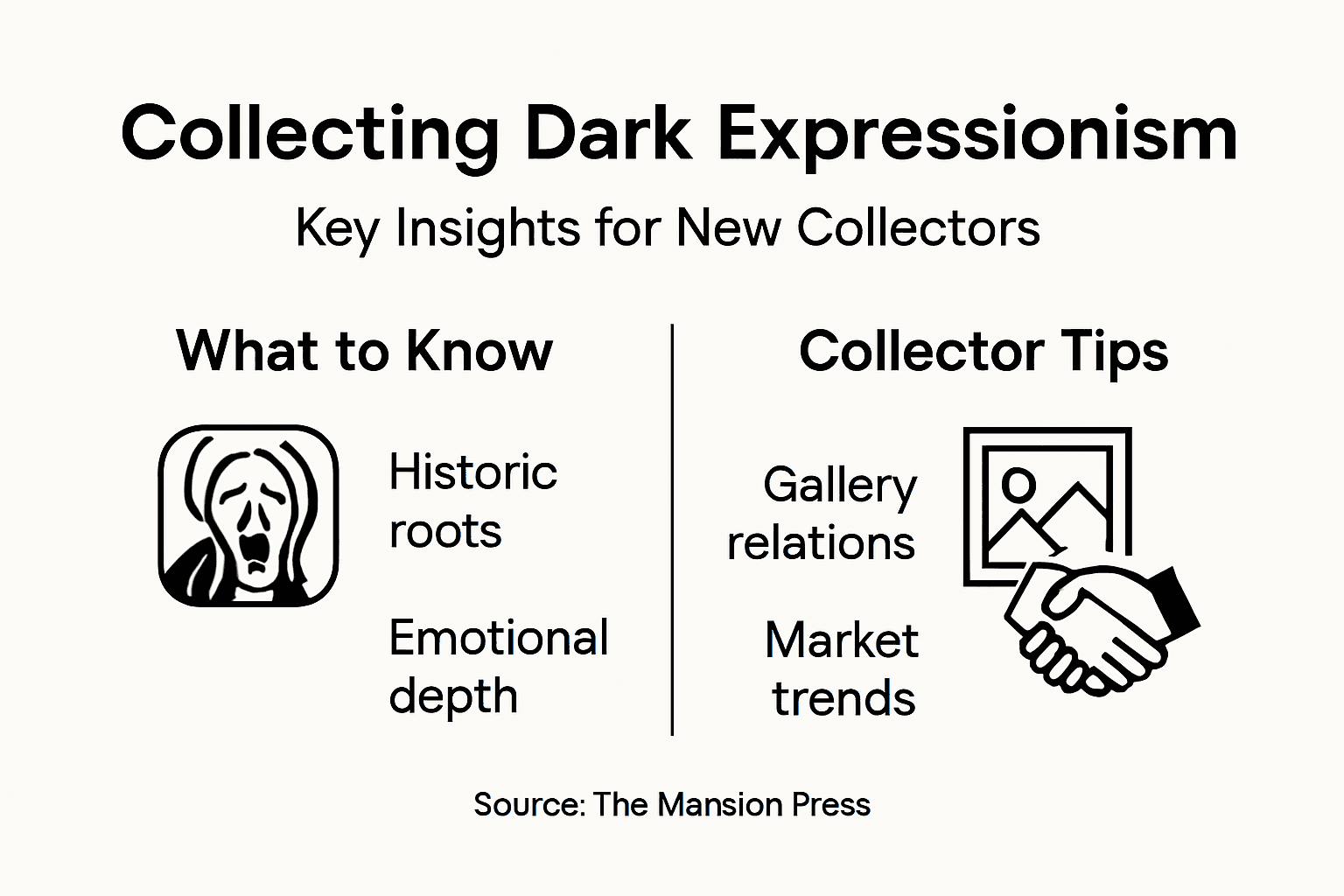
Serious collectors must develop critical skills to navigate this unique art market. Authenticity Verification becomes paramount, involving comprehensive research into an artwork’s historical origins, artist background, and cultural context. Understanding the emotional and psychological underpinnings of each piece distinguishes sophisticated collectors from casual art enthusiasts.
Key considerations for Dark Expressionism art collectors include:
- Provenance documentation and historical authenticity
- Artist reputation and historical significance
- Emotional depth and psychological complexity
- Technical execution and stylistic innovation
- Condition and preservation status
The market for Dark Expressionist works remains sophisticated and selective. Collectors should focus on understanding the psychological narratives embedded in each piece, recognizing that these artworks represent more than visual objects - they are profound emotional documents. Emerging and established collectors alike must develop nuanced perspectives that transcend surface-level aesthetic appreciation.
Pro tip: Build relationships with specialized galleries and auction houses that understand the intricate psychological dimensions of Dark Expressionist art, as expert insight is crucial in making informed collecting decisions.
Popular Misconceptions and Common Pitfalls
Abstract Expressionism challenges traditional assumptions about artistic movements, revealing complex layers of misunderstanding that permeate Dark Expressionist art appreciation. Many collectors and enthusiasts approach this genre with preconceived notions that can significantly limit their understanding and engagement.
One of the most prevalent Misconception Traps involves reducing Dark Expressionism to mere visual shock value. In reality, these artworks represent profound psychological explorations that demand nuanced interpretation. Collectors often mistakenly believe that emotional intensity equates to technical simplicity, overlooking the sophisticated artistic techniques underlying each piece.
Common misconceptions about Dark Expressionism include:
- Assuming all works are deliberately provocative
- Believing emotional art lacks technical sophistication
- Equating darkness with negativity
- Thinking the genre is limited to specific cultural contexts
- Overlooking the historical and psychological complexity
Understanding Dark Expressionism requires moving beyond surface-level interpretations. Serious collectors must recognize that these artworks are complex psychological documents, not mere aesthetic objects. The genre’s depth lies in its ability to communicate intricate emotional landscapes that transcend traditional representational boundaries.
Pro tip: Develop a critical perspective by studying the historical and psychological context of each artwork, rather than relying on initial emotional reactions or superficial interpretations.
Discover the Emotional Power of Dark Expressionism Through Unique Art and Collectibles
The article highlights the deep psychological complexity and raw emotional intensity that define Dark Expressionism art. Many collectors and enthusiasts struggle to find authentic pieces that truly capture these profound emotional narratives while also understanding the historical and artistic context. If you are drawn to art that breaks boundaries with bold colors, distorted forms, and intense symbolism, finding limited editions and original artworks that resonate with those themes can be challenging.
Explore a curated selection of exclusive artbooks, original artworks, and collector’s editions at The Mansion Press that embody the very essence of Dark Expressionism. Our collections are tailored for passionate art lovers who seek more than surface aesthetics and want to connect with the emotional depth behind every piece.
Experience expressive visuals and psychological storytelling with carefully selected pieces from independent artists who embrace the spirit of this movement.
Unlock access to a world where Dark Expressionism meets collector’s passion. Start your journey now at The Mansion Press and take advantage of our exclusive releases and pre-orders before they are gone. Discover artworks that speak to the emotional rawness and vulnerability celebrated in the article. Visit The Mansion Press today and find the perfect piece to deepen your collection.
Frequently Asked Questions
What is Dark Expressionism?
Dark Expressionism is an artistic movement that focuses on the raw emotional landscape of human experience, emphasizing psychological intensity through visual distortion rather than realistic representation.
How does Dark Expressionism differ from traditional art forms?
Dark Expressionism prioritizes inner emotional experiences and often employs exaggerated forms and jarring color palettes, while traditional art forms aim for accurate appearances and naturalistic representation.
Who are some key artists associated with Dark Expressionism?
Notable artists include Edvard Munch, Vincent van Gogh, and Ernst Ludwig Kirchner, who created works that conveyed complex emotional landscapes through unique artistic styles.
What should collectors consider when acquiring Dark Expressionism art?
Collectors should focus on provenance, artist reputation, emotional depth, and technical execution of the art, ensuring a thorough understanding of the psychological narratives behind each piece.