

Dark Expressionism Art: Emotional Impact for Collectors
The search for truly unique visual experiences draws collectors toward art movements that push emotional boundaries. Dark Expressionism stands out for its bold confrontation with psychological tension through shadow and muted tones, transforming familiar forms into fragmented, unsettling visions. This genre appeals to those who value emotional authenticity and depth over traditional beauty, offering insight into how psychological exploration becomes the core of art itself.
Table of Contents
- Defining Dark Expressionism Art Fundamentals
- Styles and Distinctive Traits of Dark Expressionism
- Influential Artists and Movement Origins
- Collector Value: Rarity and Authenticity Factors
- Misconceptions and Mistakes in Dark Expressionist Art
Key Takeaways
| Point | Details |
|---|---|
| Emotional Authenticity | Dark Expressionism emphasizes genuine emotional exploration through unsettling visual narratives and psychological depth. |
| Artistic Techniques | Artists employ extreme distortions, chromatic dissonance, and fragmented representations to challenge viewer perceptions. |
| Collector Value | Rarity and authenticity are crucial; factors include artist documentation, historical context, and psychological narratives. |
| Common Misconceptions | Many collectors mistakenly view these artworks as merely shocking, overlooking the complex emotional subtleties and narratives within. |
Defining Dark Expressionism Art Fundamentals
Dark Expressionism represents a profound artistic movement that transcends traditional visual representation, delving deep into the psychological landscapes of human emotion through stark, intense imagery. This art form emerges from a radical departure from conventional aesthetic standards, focusing instead on conveying raw, unfiltered psychological states through distorted, often unsettling visual narratives.
The fundamental characteristics of Dark Expressionism are rooted in its commitment to emotional authenticity and psychological exploration. Artists working within this genre deliberately challenge viewers’ comfort zones by:
- Utilizing high-contrast color palettes
- Employing deliberate visual distortions
- Creating intentionally uncomfortable visual compositions
- Representing complex emotional states through abstract forms
Dark art themes reveal powerful psychological undercurrents that challenge traditional artistic representations. These works are not merely aesthetic exercises but intense psychological investigations that transform personal trauma, societal tensions, and inner emotional landscapes into visual experiences.
Artists in the Dark Expressionism movement frequently employ techniques that deliberately destabilize visual perceptions, including extreme perspective shifts, grotesque human representations, and symbolic imagery that communicates emotional experiences beyond literal interpretation. By rejecting aesthetic pleasantness, these creators force viewers to confront uncomfortable psychological territories, transforming art into a visceral, emotional dialogue.
Pro tip: When collecting Dark Expressionism artworks, focus on pieces that provoke genuine emotional responses rather than merely shocking visual elements.
Styles and Distinctive Traits of Dark Expressionism
Dark Expressionism emerges as a radical artistic approach that transcends traditional visual representation, characterized by its intense psychological landscapes and deliberately provocative aesthetic strategies. Unique dark art movements challenge conventional artistic boundaries by transforming emotional complexity into visceral visual experiences.
The distinctive stylistic elements of Dark Expressionism include:
- Deliberate chromatic dissonance
- Fragmented human representations
- Symbolic psychological distortions
- Intense emotional layering
- Rejection of aesthetic pleasantness
Artists within this genre strategically deploy visual techniques that destabilize viewer expectations. They utilize shadow, muted dark tones, and intentional visual disruptions to create psychological tension. Color becomes a language of emotional communication, with muddy, layered palettes generating a sense of unresolved emotional terrain.
Psychological exploration remains central to Dark Expressionism, where artists deconstruct human experience through intentionally uncomfortable visual narratives. The style ranges from aggressive, chaotic compositions to quiet, introspective representations, always maintaining a commitment to revealing inner emotional landscapes that traditional art forms typically conceal.

Pro tip: When collecting Dark Expressionism artworks, prioritize pieces that demonstrate technical mastery of psychological representation over mere shock value.
Influential Artists and Movement Origins
Dark Expressionism emerged from the foundational roots of early 20th-century Expressionism, a movement that radically challenged traditional artistic representation. Underground art movements transformed artistic perception by prioritizing emotional intensity over visual realism.
The pivotal artists who shaped this movement’s trajectory include several groundbreaking figures:
- Edvard Munch: Pioneer of psychological portraiture
- Ernst Ludwig Kirchner: Master of distorted urban landscapes
- Wassily Kandinsky: Innovator of abstract emotional expression
- Francis Bacon: Provocateur of human psychological fragmentation
- Max Beckmann: Explorer of existential human complexity
Originally rooted in German artistic circles, Expressionism represented a profound psychological rebellion against academic realism. Artists deliberately distorted human forms, utilized aggressive color palettes, and created visual narratives that exposed raw emotional experiences. These techniques became foundational for Dark Expressionism, which further intensified the movement’s commitment to psychological exploration.
Here’s a summary of how Dark Expressionism differs from traditional Expressionism:
| Characteristic | Expressionism | Dark Expressionism |
|---|---|---|
| Artistic Focus | Emotional intensity | Psychological depth and discomfort |
| Visual Techniques | Distorted forms, bold colors | Extreme distortion, chromatic dissonance |
| Emotional Purpose | Showing feelings | Exploring trauma and inner turmoil |
| Viewer Experience | Provokes thought | Confronts and unsettles |
Contemporary Dark Expressionist artists continue this legacy by pushing psychological boundaries, creating works that challenge viewers’ perceptions of emotional representation. They transform personal trauma, societal tensions, and inner psychological landscapes into visceral visual experiences that transcend traditional artistic conventions.
Pro tip: When collecting Dark Expressionist works, research the artist’s psychological motivations to truly understand the artwork’s deeper emotional significance.
Collector Value: Rarity and Authenticity Factors
In the complex world of Dark Expressionism art collecting, rarity and authenticity emerge as critical determinants of an artwork’s intrinsic and monetary value. Rare art book collectors understand that provenance and unique characteristics dramatically influence an artwork’s desirability and investment potential.
Key factors that significantly impact a Dark Expressionist artwork’s collector value include:
- Original artist signatures and documentation
- Limited edition status
- Condition of the artwork
- Historical significance
- Psychological complexity and emotional depth
- Documented exhibition history
- Verifiable artistic lineage
Authentication in Dark Expressionism requires meticulous research and expert verification. Collectors must develop sophisticated skills to distinguish genuine works from potential reproductions. This process involves comprehensive examination of artistic techniques, material composition, stylistic consistency, and historical context specific to the artist’s unique psychological approach.
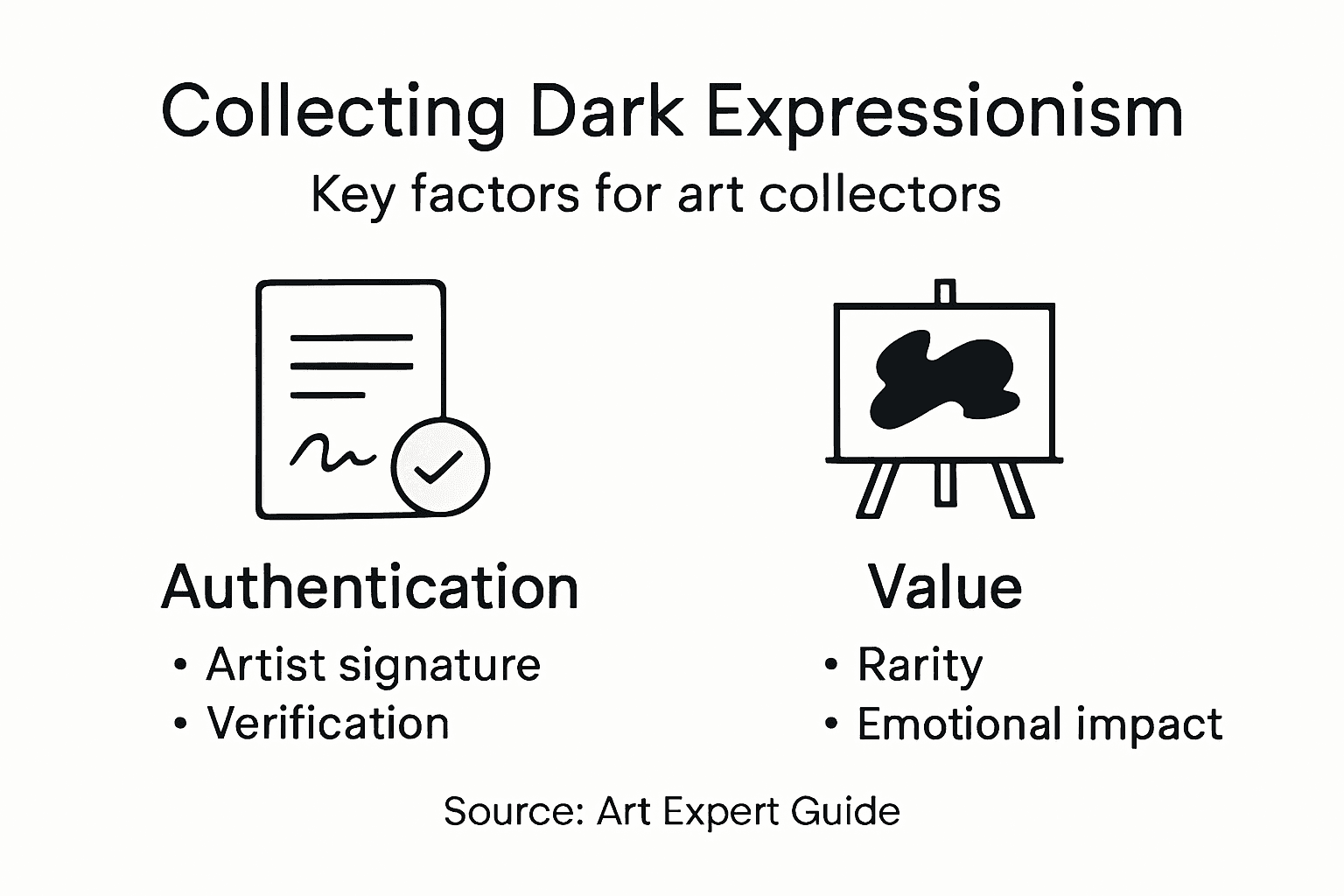
Psychological provenance becomes equally crucial in determining an artwork’s value. Collectors seek pieces that not only demonstrate technical mastery but also reveal profound emotional narratives. The most valuable Dark Expressionist works transcend mere visual representation, offering deep psychological insights that challenge conventional artistic boundaries.
Collectors should understand these authentication and value factors for Dark Expressionist art:
| Factor | Importance | What to Look For |
|---|---|---|
| Artist Documentation | Confirms authenticity | Signed certificates, artist records |
| Historical Context | Adds collectible value | Exhibition history, movement ties |
| Psychological Narrative | Indicates emotional significance | Unique personal or societal story |
| Condition | Impacts long-term value | Minimal damage, stable materials |
Pro tip: Always request comprehensive documentation and expert authentication before making significant investments in Dark Expressionist artworks.
Misconceptions and Mistakes in Dark Expressionist Art
Dark Expressionist art collectors frequently encounter numerous misconceptions that can significantly impact their understanding and appreciation of this complex artistic genre. Psychology behind dark art reveals that many collectors misinterpret the movement’s fundamental intentions and emotional depth.
Common misconceptions about Dark Expressionist art include:
- Believing the art is solely about shock value
- Assuming all works are intentionally ugly or disturbing
- Thinking psychological complexity equates to technical weakness
- Misinterpreting emotional depth as mere negativity
- Overlooking the nuanced emotional narrative
Many novice collectors mistakenly approach Dark Expressionism as a monolithic genre, failing to recognize the profound psychological subtleties that distinguish truly exceptional works. The most critical error is reducing these artworks to simple provocative statements, when in reality, they represent intricate explorations of human emotional landscapes.
Authentic Dark Expressionist art demands intellectual and emotional engagement beyond superficial visual interpretation. Collectors must develop a sophisticated understanding that goes beyond aesthetic preferences, recognizing how these works challenge traditional representational boundaries and expose complex psychological states.
Pro tip: Develop a critical perspective by studying the artist’s psychological motivations rather than focusing exclusively on the artwork’s visual shock value.
Discover and Collect Dark Expressionism Art That Speaks to Your Soul
Dark Expressionism challenges art collectors to engage with the raw psychological depth and emotional complexity that traditional art often overlooks. If you seek artworks that confront inner turmoil and evoke genuine emotional responses, navigating the rarity and authenticity aspects can feel overwhelming. Collectors looking to invest in pieces that reveal profound psychological narratives will appreciate carefully curated selections highlighting technical mastery and meaningful storytelling.
Explore exclusive artbooks, limited edition prints, and original works that embody the spirit of Dark Expressionism at The Mansion Press. Elevate your collection now with carefully authenticated treasures designed to provoke thought and stir deep emotions. Start your journey today by visiting The Mansion Press website and uncover the unique artist showcases that connect you directly with creators pushing the boundaries of psychological expression.
Frequently Asked Questions
What is Dark Expressionism art?
Dark Expressionism art focuses on conveying raw psychological states and emotional depth, often utilizing distorted visual narratives to explore complex human emotions.
How can I identify authentic Dark Expressionism artworks?
Authenticating Dark Expressionism involves examining original artist signatures, documentation, condition, historical significance, and emotional depth to ensure the artwork’s provenance and value.
What are the key characteristics of Dark Expressionism art?
Key characteristics include high-contrast color palettes, visual distortions, uncomfortable compositions, and the representation of complex emotional states through abstract forms.
How does collecting Dark Expressionism art differ from traditional art collecting?
Collecting Dark Expressionism art involves prioritizing psychological narratives and emotional impact over mere aesthetic qualities, requiring a deeper understanding of the artist’s intentions and emotional exploration.
Recommended
- Dark Expressionism Art: Power and Emotional Depth – The Mansion Press
- Psychology Behind Dark Art – Why It Resonates – The Mansion Press
- Dark Art Themes: Impact on Modern Art Collecting – The Mansion Press
- Understanding Finding Inspiration in Dark Art – The Mansion Press
- Role of Color in Wall Art: Creating Lasting Emotional Impact