

Explore circle of life art: unique originals for collectors
Most collectors assume circle of life art means predictable, clichéd imagery: sunsets, lions, or cheesy motivational posters. This misconception costs you access to some of the most innovative, emotionally resonant works available today. The circle of life theme explores cyclical patterns, reflecting birth, growth, change, and renewal in ways that challenge expectations and deepen your collection’s narrative power. Independent artists worldwide interpret this ancient motif through experimental techniques, bold color theory, and symbolic depth that transforms how you experience art. This guide reveals how to recognize authentic circle of life artworks, evaluate their quality using professional criteria, and support the creators pushing this theme into unexpected territory.
Table of Contents
- Understanding The Circle Of Life Theme In Art
- Techniques And Mediums In Circle Of Life Artworks
- Evaluating And Collecting Circle Of Life Art
- Supporting Independent Artists And Enhancing Your Collection
- Discover Unique Circle Of Life Art And Support Artists Today
- Frequently Asked Questions
Key takeaways
| Point | Details |
|---|---|
| Cyclical symbolism | The circle of life theme embodies birth, growth, death, and renewal through diverse artistic interpretations. |
| Medium diversity | Artists employ acrylics, mixed media, digital art, and experimental techniques to express the theme. |
| Evaluation framework | Assess artworks through craftsmanship, originality, thematic depth, and artist intent. |
| Independent artist value | Supporting emerging creators provides access to unique pieces unavailable in traditional retail. |
| Collection enhancement | Understanding symbolism and context enriches appreciation and investment potential. |
Understanding the circle of life theme in art
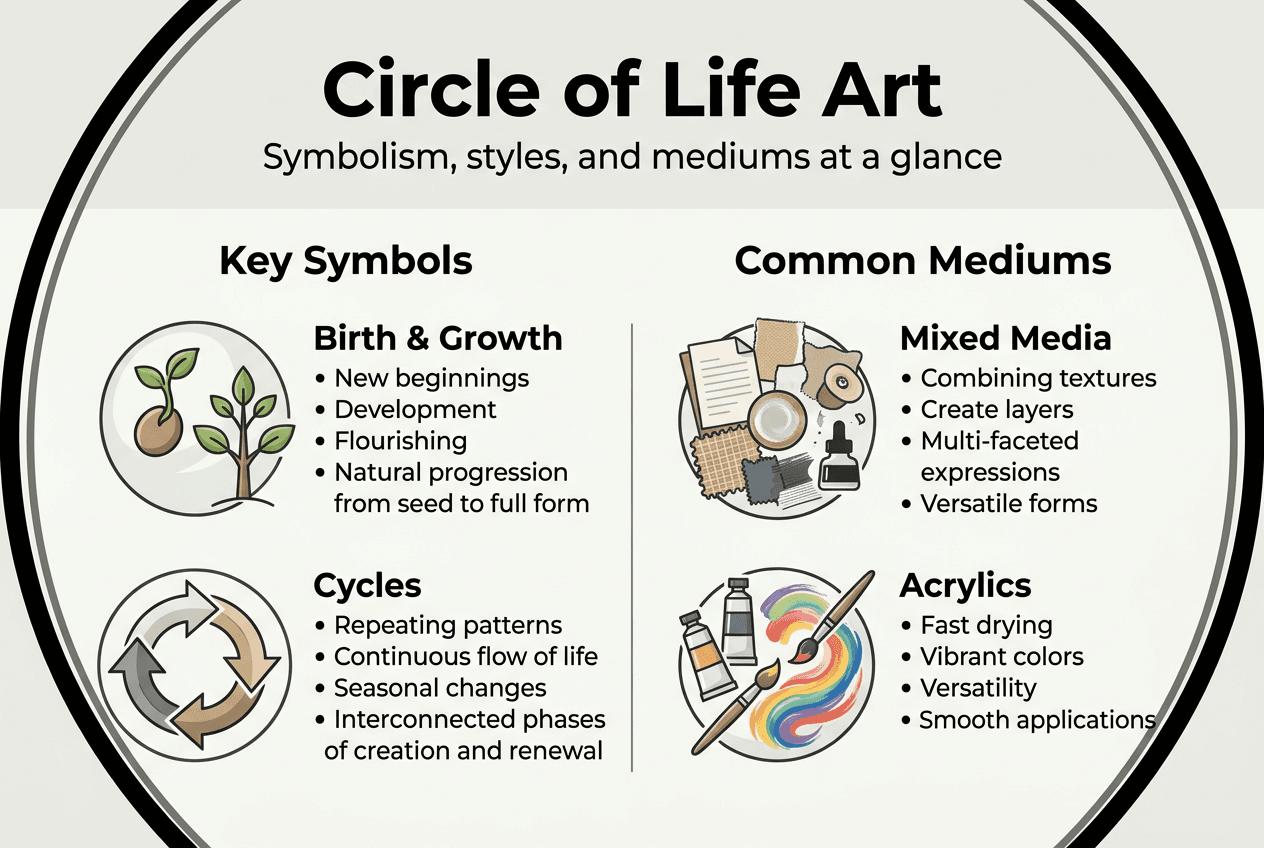
The circle of life theme captures something fundamental about existence: nothing remains static. Artworks use symbolic representations of cyclical processes like birth, growth, death, and rebirth to express interconnectedness across time and space. This isn’t abstract philosophy packaged as decoration. Artists translate universal patterns into visual language that resonates emotionally because you recognize these cycles in your own experience.
Common visual metaphors anchor the theme in recognizable imagery. You’ll encounter recurring symbols across different artistic styles:
- Sun and moon cycles representing day, night, and temporal progression
- Seasonal transitions showing nature’s perpetual renewal
- Water imagery depicting flow, transformation, and continuity
- Botanical growth patterns illustrating life stages
- Animal symbolism connecting instinct with evolutionary cycles
The theme’s appeal to collectors stems from its dual nature: immediately accessible yet endlessly interpretable. A well-executed circle of life piece functions on multiple levels simultaneously. Surface beauty draws you in, while layered symbolism rewards repeated viewing. This depth separates serious artistic exploration from superficial decoration.
Cultural origins vary dramatically, enriching the theme’s contemporary expressions. Eastern philosophies contribute concepts of eternal return and karmic cycles. Indigenous traditions offer perspectives on human relationships with natural rhythms. Western art history adds mythological frameworks and scientific observation. When you examine symbolism in modern art, you discover how contemporary creators synthesize these diverse influences into fresh interpretations.
The cyclical motif captivates because it acknowledges both permanence and change. Life’s patterns repeat, yet each iteration brings unique variations. Artists who grasp this paradox create works that feel simultaneously timeless and urgently contemporary. Your collection gains philosophical weight when you acquire pieces that wrestle with existence’s fundamental rhythms rather than merely depicting pretty nature scenes.
Techniques and mediums in circle of life artworks
Artistic innovation transforms abstract concepts into tangible visual experiences. Artists employ mixed media, oil, acrylic, and digital art to showcase the theme’s versatility across traditional and contemporary approaches. Medium selection isn’t arbitrary. Each material offers distinct possibilities for expressing cyclical motion, temporal layering, or transformative processes.
Acrylics dominate contemporary circle of life works because they dry quickly, allowing rapid layering that mimics natural accumulation. You can observe how artists build depth through transparent washes, then add opaque details that emerge like memories surfacing. Mixed media takes this further by incorporating unexpected materials: fabric suggesting texture and mortality, metal elements representing permanence, organic matter decomposing within resin to literalize decay and preservation simultaneously.
Color experimentation drives emotional impact in ways collectors often underestimate. Techniques like stenciling, stamping, and doodling add depth when combined with strategic color placement. Artists test how warm tones advance while cool colors recede, creating spatial illusions that suggest movement through time. Background choices dramatically alter perception. A vibrant orange appears aggressive on white but contemplative on deep blue.
Pro Tip: When evaluating circle of life artworks, examine how artists handle color transitions between symbolic elements to assess their technical sophistication and thematic coherence.
Layering techniques separate amateur efforts from professional execution. Watch for these approaches when assessing innovative artistic techniques:
- Glazing builds luminosity through transparent color applications
- Impasto creates physical texture suggesting organic growth
- Sgraffito reveals underlayers, implying hidden histories
- Collage fragments suggest discontinuity within cycles
- Digital manipulation allows impossible juxtapositions
Patience distinguishes meaningful work from rushed production. Serious artists iterate obsessively, testing compositions and color relationships until achieving precise emotional resonance. You’ll notice this dedication in finished pieces: nothing feels accidental, yet the work maintains spontaneity. Advanced painting techniques require both technical mastery and willingness to destroy promising starts that don’t quite achieve the intended effect.

Enamel accents and metallic elements introduce reflective qualities that change as lighting shifts throughout the day. This temporal variability reinforces cyclical themes by ensuring the artwork itself transforms with environmental conditions. Your experience viewing the piece at dawn differs fundamentally from evening observation, mirroring natural cycles the work explores conceptually.
Evaluating and collecting circle of life art
Professional evaluation prevents costly mistakes when building your collection. Criteria include craftsmanship, technique, theme relevance, originality, and creativity applied systematically rather than relying on subjective impressions alone. Emotional response matters, but informed judgment protects your investment and ensures acquisitions maintain value over time.
Follow this systematic approach when assessing potential acquisitions:
- Examine technical execution under varied lighting to reveal surface quality and layering sophistication
- Research the artist’s background, exhibition history, and critical reception to contextualize the work
- Analyze how effectively symbolic elements communicate cyclical themes without resorting to obvious clichés
- Compare the piece against similar works to gauge originality and distinctive artistic voice
- Consider scale, presentation needs, and how the work integrates with your existing collection’s narrative
- Verify provenance and authenticity through documentation and artist verification when possible
This comparison table clarifies key evaluation dimensions:
| Aspect | Strong Indicator | Weak Indicator | | — | — | | Craftsmanship | Clean edges, intentional texture, consistent quality throughout | Uneven application, accidental drips, rushed finishing | | Originality | Unexpected symbolic combinations, distinctive style | Generic nature imagery, predictable compositions | | Thematic Depth | Multiple interpretive layers, symbolic coherence | Surface-level symbolism, disconnected elements | | Technical Skill | Controlled color transitions, sophisticated layering | Muddy colors, flat composition, poor spatial relationships |
Common pitfalls undermine collection quality when you prioritize superficial appeal over substantive artistic merit. Avoid works that rely on obvious symbolism without adding interpretive complexity. A painting featuring a butterfly emerging from a cocoon isn’t automatically profound. Execution and conceptual framework determine whether the piece transcends greeting card aesthetics.
Pro Tip: Investigate whether artists employ methods like dividing portraits into squares or other systematic approaches to enhance detail and maintain proportional accuracy throughout complex compositions.
Authenticity verification becomes crucial as circle of life themes gain market attention. Request documentation showing the work’s creation process, exhibition history, or critical commentary. Established artists maintain records proving authenticity. Emerging creators should provide clear provenance even without extensive exhibition backgrounds.
When examining evaluating thematic art, consider how effectively pieces balance accessibility with intellectual challenge. The strongest circle of life artworks invite immediate emotional engagement while rewarding sustained contemplation with deeper insights. Your collection should spark conversations that extend beyond simple aesthetic appreciation into meaningful discussions about existence, transformation, and continuity.
Supporting independent artists and enhancing your collection
Independent creators drive innovation within circle of life themes because they’re unconstrained by commercial pressures demanding safe, marketable imagery. Supporting independent artists provides access to unique interpretations unavailable through traditional galleries focused on established names and predictable styles. Your patronage directly enables experimental work that pushes thematic boundaries and technical possibilities.
Emerging artists bring fresh perspectives shaped by contemporary concerns: climate change, technological transformation, social upheaval. Their circle of life interpretations reflect current anxieties and hopes rather than recycling historical approaches. You gain works that capture this specific cultural moment while engaging timeless themes, creating collection pieces that document both personal taste and broader societal evolution.
Discover independent circle of life artists through these strategic approaches:
- Virtual exhibitions and online galleries specializing in thematic collections
- Artist collectives and cooperatives promoting members working with cyclical motifs
- Social media platforms where creators share process documentation and finished works
- Art fairs and local exhibitions featuring emerging talent before gallery representation
- Direct studio visits allowing deeper engagement with artistic practice and philosophy
Advantages for collectors extend beyond acquisition costs, though independent artists typically price works more accessibly than gallery-represented counterparts. You develop direct relationships with creators, gaining insights into conceptual frameworks and technical decisions that enrich your understanding. This personal connection transforms collecting from transactional purchasing into collaborative cultural participation.
Emotional resonance intensifies when you know the artist’s story and creative journey. A circle of life piece commemorating personal loss or celebrating renewal carries additional meaning when you understand its biographical context. These narratives become part of your collection’s story, adding depth that purely aesthetic appreciation cannot provide.
Investment potential shouldn’t dominate collecting decisions, but supporting emerging talent positions you advantageously if artists gain recognition. Early acquisitions from creators who later achieve critical success appreciate significantly. More importantly, you’ve supported artistic development during crucial early career stages when patronage matters most.
Connecting with art communities specializing in thematic work expands your knowledge and acquisition opportunities. Join collector groups focused on supporting independent artists to share insights, discover new creators, and participate in discussions that sharpen your evaluative skills. These networks provide access to private sales, studio visits, and advance notice about upcoming exhibitions.
Enhancing collection diversity through independent artist support prevents homogenization. Major galleries promote similar aesthetics because market pressures encourage safe choices. Independent creators explore risky territory, producing works that challenge conventional taste. Your collection gains narrative depth and visual variety by including pieces that provoke alongside works that comfort.
Discover unique circle of life art and support artists today
Your journey into circle of life art collecting starts with platforms connecting you directly to creators pushing thematic boundaries. Specialized retailers curate selections emphasizing originality and artistic merit over mass appeal, ensuring you encounter works worthy of serious consideration. These unique art collections showcase pieces unavailable through conventional channels, offering exclusivity that enhances both aesthetic and investment value.

Staying informed about upcoming art exhibitions positions you to acquire significant works before broader market recognition drives prices upward. Virtual exhibitions democratize access, eliminating geographic barriers that previously limited collector opportunities. You can evaluate pieces thoughtfully, research artists thoroughly, and make informed decisions without time pressure.
Integrating new acquisitions into existing collections requires strategic consideration of thematic relationships, visual balance, and spatial dynamics. Circle of life pieces often function as anchor works around which other artworks orbit, their cyclical themes providing conceptual coherence. When you discover independent artists working with these motifs, you’re not just buying decoration but investing in cultural conversations that extend beyond individual pieces into broader questions about existence, meaning, and artistic expression.
Frequently asked questions
What is the symbolism behind circle of life art?
Circle of life art symbolizes the perpetual cycles of birth, growth, death, and renewal that govern natural and human existence. These works explore interconnectedness across time, suggesting that endings enable new beginnings and that individual lives participate in larger patterns. Artists use recurring visual motifs like seasonal changes, lunar phases, and generational succession to make abstract philosophical concepts tangible and emotionally resonant.
How can I identify authentic and original circle of life artworks?
Authentic circle of life artworks demonstrate craftsmanship, thematic depth, and originality rather than relying on clichéd imagery or superficial symbolism. Examine technical execution quality, research the artist’s background and exhibition history, and verify provenance through documentation. Strong pieces balance immediate accessibility with interpretive complexity, rewarding sustained contemplation with deeper insights into cyclical themes.
What mediums do artists commonly use for circle of life themes?
Artists employ mixed media, acrylics, oil painting, digital art, and experimental techniques to express circle of life themes across traditional and contemporary approaches. Many creators combine materials strategically, using transparent washes for temporal layering and opaque details for emphasis. Color experimentation and techniques like stenciling, stamping, and layering enhance symbolic depth, while unconventional materials like fabric, metal, or organic matter literalize concepts of transformation and permanence.
How does supporting independent artists benefit art collectors?
Supporting independent artists provides access to unique, original works with emotional resonance unavailable through commercial galleries focused on established names. You develop direct relationships with creators, gaining insights into conceptual frameworks that enrich your understanding and collection narrative. Early acquisitions from emerging talent offer investment potential while sustaining vibrant, diverse art communities that drive innovation within thematic exploration like circle of life motifs.
Recommended
- Limited Editions as Ritual Objects: Why Kago Collector Versions Matter – The Mansion Press
- Counterculture Art: 80% Symbolism & Limited Editions – The Mansion Press
- Icons vs Artbooks: Two Faces of the Same Artist – The Mansion Press
- Understanding Unique Illustration Styles: A Deep Dive – The Mansion Press