

Counterculture Art: 80% Symbolism & Limited Editions
Counterculture art auction prices have jumped 150% over the past decade, yet many collectors struggle to separate authentic pieces from mass-produced replicas. The challenge isn’t just spotting a peace sign or psychedelic pattern. It’s understanding the social rebellion, ideological roots, and provenance that define genuine counterculture work. This guide clarifies what counterculture art truly means, how to verify authenticity, and where to find limited editions that honor the movement’s subversive spirit.
Table of Contents
- Defining Counterculture Art and Its Origins
- Historical Evolution of Counterculture Art
- Themes and Symbols in Counterculture Art
- Collector Strategies and Authenticity Verification
- Modern Channels for Counterculture Art Distribution
- Common Misconceptions About Counterculture Art
- Bridging Understanding to Practical Application
- Explore Exclusive Limited Editions At The Mansion Press
- Counterculture Art FAQ
Key Takeaways
| Point | Details |
|---|---|
| Definition | Counterculture art subverts mainstream norms and emerges from social dissent movements. |
| Symbolism | Over 80% of pieces use icons like peace signs, anarchy emblems, and psychedelic motifs. |
| Authenticity | Limited editions and documented provenance ensure genuine works, not replicas. |
| Distribution | Independent artists bypass galleries using social media and niche platforms for direct sales. |
| Value Myth | Despite anti-commercial roots, counterculture art prices rose 150% in ten years. |
Defining Counterculture Art and Its Origins
Counterculture art is visual dissent made tangible. It challenges dominant cultural values through imagery rooted in social and political rebellion. Rather than decorating walls, these works question authority, celebrate alternative lifestyles, and give voice to marginalized communities. The Beat Generation of the 1950s laid early groundwork, rejecting conformity through spontaneous creative expression and anti-establishment themes.
Style alone doesn’t make art counterculture. A paisley pattern on canvas isn’t automatically subversive. True counterculture pieces connect to specific social movements, whether civil rights, anti-war protests, or LGBTQ+ liberation. Context matters as much as aesthetics. You need to trace the artwork’s origin, understand the artist’s intent, and verify its connection to actual dissent rather than commercial imitation.
Authenticity anchors in two practical elements: provenance and limited editions. Provenance documents the artwork’s history from creation to current ownership. Limited editions preserve scarcity, preventing mass reproduction that dilutes meaning. When you encounter a print numbered 12/50, you’re seeing intentional restraint. The artist chose to create only 50 copies, maintaining exclusivity and honoring collectors who value rarity.
Pro Tip: Research the social movement tied to an artwork before purchasing. Genuine counterculture pieces emerge from lived experience, not marketing departments mimicking rebellion for profit.
Key attributes of authentic counterculture art include:
- Direct challenge to mainstream cultural norms and institutions
- Roots in documented social or political movements
- Artist biography showing engagement with counterculture communities
- Limited production runs or unique pieces
- Provenance linking the work to its original context
The underground art movements that spawned counterculture work operated outside traditional gallery systems. Artists distributed through independent bookstores, music venues, and protest spaces. This alternative distribution wasn’t just practical. It embodied the anti-establishment ethos central to the movement itself.
Historical Evolution of Counterculture Art
The 1960s exploded with counterculture expression. Beat poets like Allen Ginsberg influenced visual artists who merged Eastern spirituality, psychedelic experimentation, and anti-war messaging into vibrant posters and album covers. Hippie-era art embraced organic forms, rainbow palettes, and utopian imagery. San Francisco’s Haight-Ashbury district became a creative laboratory where artists like Rick Griffin and Victor Moscoso designed concert posters that doubled as visual manifestos.
Punk subculture art emerged in late 1970s Britain and New York as a raw rejection of hippie idealism. Punk aesthetics favored torn paper, ransom-note typography, and confrontational imagery. Artists like Jamie Reid created iconic Sex Pistols album covers using cut-and-paste techniques that anyone with scissors could replicate. This DIY ethos democratized art creation, making rebellion accessible without formal training.
Global diffusion followed as counterculture themes adapted to local contexts. Japanese underground comics blended punk energy with manga traditions. Latin American artists merged counterculture symbolism with indigenous imagery and political resistance art. Each region reinterpreted core themes through its cultural lens while maintaining the fundamental spirit of challenging power structures.
Thematic shifts reflected evolving social priorities:
- 1960s: Anti-war protests, civil rights, sexual liberation
- 1970s: Environmentalism, feminism, punk nihilism
- 1980s: AIDS activism, anti-apartheid, hardcore punk
- 1990s: Riot grrrl, zine culture, alter-globalization
- 2000s-present: Digital resistance, climate justice, intersectional movements
Understanding these historical counterculture movements helps you assess whether a piece truly belongs to the tradition or simply borrows its aesthetic surface. Authentic works carry historical weight, connecting to specific moments when artists risked reputation or safety to voice dissent.
Themes and Symbols in Counterculture Art
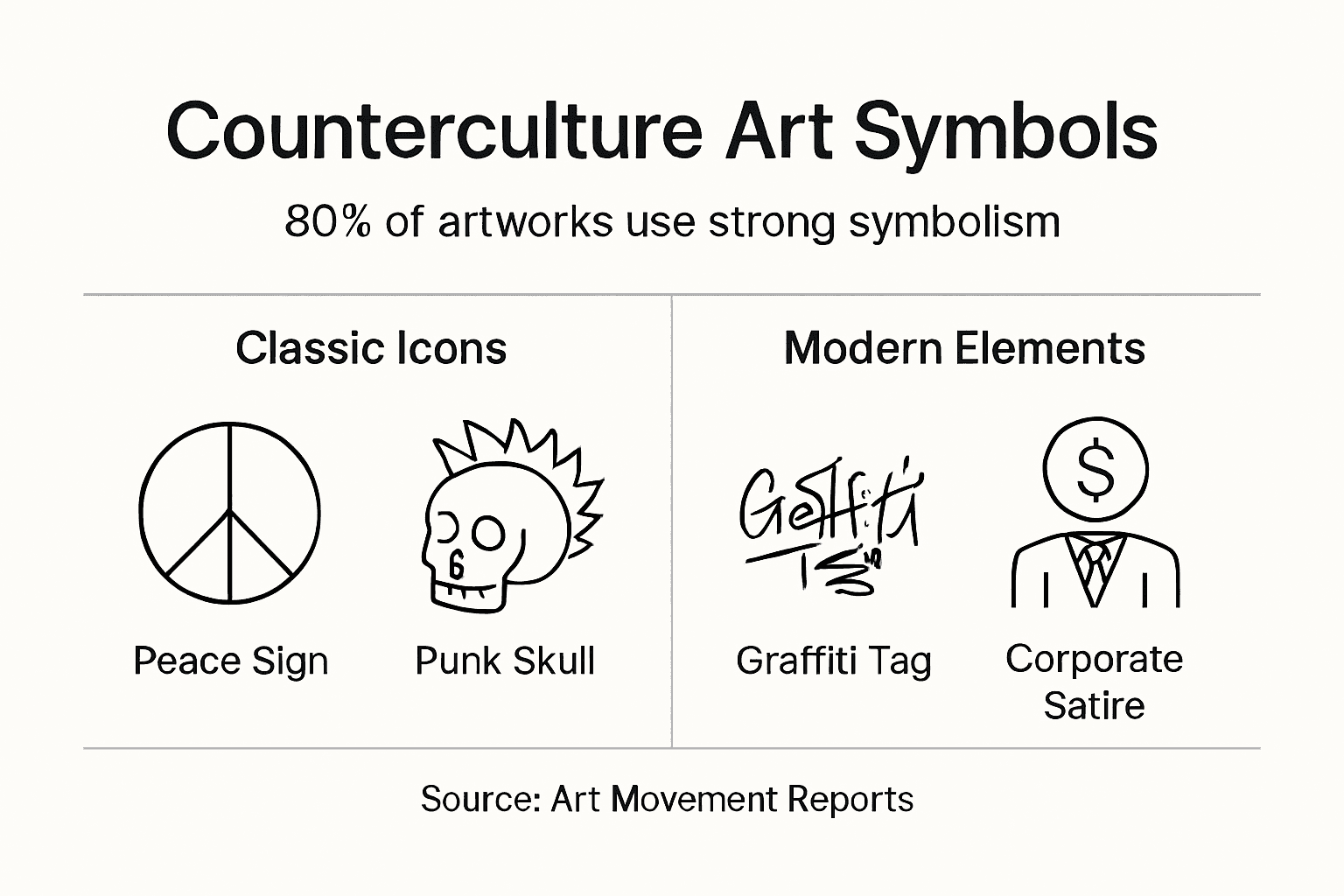
Over 80% of counterculture artworks incorporate recognizable symbols that function as visual shorthand for complex ideologies. The peace sign, designed in 1958 for nuclear disarmament, became synonymous with anti-war movements. The anarchy symbol, a capital A within a circle, represents order emerging from chaos and rejection of hierarchical power. Psychedelic patterns using Op Art techniques symbolize altered consciousness and transcendence beyond conventional perception.
Satire and subversion provoke reflection by twisting familiar imagery. Artists appropriate corporate logos, political figures, and consumer products, revealing contradictions in mainstream culture. Barbara Kruger’s bold text overlays on photographs critique consumerism and patriarchy. Banksy’s street art transforms public spaces into political commentary zones where anyone passing by confronts uncomfortable truths.
A shared visual language connects diverse countercultures across time and geography. Whether examining 1960s San Francisco posters or 2020s climate protest art, you’ll find recurring motifs: raised fists, doves, roses growing through concrete, eyes opening to truth. These symbols create continuity, letting new generations build on established traditions while addressing contemporary struggles.

| Symbol | Movement | Ideological Association |
|---|---|---|
| Peace Sign | Anti-war | Nuclear disarmament, nonviolent resistance |
| Anarchy A | Punk/Anarchist | Rejection of state authority, self-governance |
| Raised Fist | Civil Rights | Solidarity, resistance, collective power |
| Psychedelic Spirals | Hippie/Rave | Consciousness expansion, transcendence |
| Safety Pin | Punk | DIY ethos, making do with limited resources |
Pro Tip: Subtle symbolism often reveals deeper authenticity. Look for layered meanings and cultural references that require historical knowledge to decode. Simplistic symbol use may indicate commercial reproduction rather than genuine counterculture engagement.
Common visual techniques include:
- High contrast and bold color choices demanding attention
- Collage and assemblage reflecting fragmented modern experience
- Hand-drawn elements rejecting mechanical precision
- Text integration making political messages explicit
- Appropriation and détournement subverting mainstream imagery
Collector Strategies and Authenticity Verification
Verifying authenticity protects your investment and ensures you’re supporting genuine artistic dissent rather than corporate co-option. 90% of reputable sales include thorough documentation. Without provenance, you’re gambling on guesswork.
Follow these steps to confirm authenticity:
- Request complete provenance documentation tracing ownership history
- Verify edition numbers match artist records and catalogs
- Examine physical characteristics like paper quality, printing technique, and signatures
- Research the artist’s biography and connection to counterculture movements
- Consult expert appraisers specializing in counterculture and underground art
- Check for certificates of authenticity from recognized institutions or the artist directly
Limited editions preserve both authenticity and value. When an artist creates only 50 prints, each becomes genuinely scarce. Compare this to mass-produced posters where thousands flood the market. Scarcity isn’t artificial marketing. It’s intentional restraint honoring collectors who seek meaningful connection rather than commodity ownership.
“The most critical authentication element is documented connection to the social movement that birthed the work. Style can be faked, but historical context and artist engagement cannot. Always investigate the artist’s lived experience within counterculture communities before purchasing.”
Artist collaboration and documentation strengthen authenticity. When artists work with printmakers, publishers, or galleries known for counterculture support, that institutional relationship provides additional verification. Look for names like Last Gasp, Fantagraphics, or similar independent publishers with decades-long reputations.
Balancing ideological authenticity with market realities requires nuance. Some collectors reject any commercial exchange as betraying counterculture values. Yet artists need to eat, pay rent, and fund future projects. Limited editions offer compromise: artists earn sustainable income while maintaining control over distribution and preventing mass commodification. When you buy original art online directly from artists or trusted independent platforms, you support continued creative resistance.
Modern Channels for Counterculture Art Distribution
Over 65% of independent counterculture artists now sell directly through social media, bypassing traditional gallery gatekeepers. Instagram, Twitter, and specialized platforms let artists build audiences, share work in progress, and announce limited edition releases without middlemen taking substantial cuts. This direct engagement strengthens provenance because you’re purchasing straight from the creator.
Popular digital platforms for counterculture art include:
- Instagram for visual portfolios and direct messaging sales
- Big Cartel and Bandcamp for independent storefronts
- Kickstarter for funding limited edition projects
- Patreon for ongoing supporter relationships
- Discord communities for insider access to new releases
| Traditional Galleries | Modern Direct Sales |
|---|---|
| Gallery takes 40-60% commission | Artist keeps 90-100% of sale price |
| Limited geographic reach | Global audience access |
| Formal exhibition schedules | Release at artist’s discretion |
| Gallery controls presentation | Artist maintains complete creative control |
| Higher barrier to entry | Accessible to emerging artists |
Niche platforms cater specifically to counterculture collectors. Sites focusing on limited edition artbooks and underground comics connect you with work rarely seen in mainstream venues. These specialized marketplaces understand the movement’s values, vetting sellers to ensure authenticity and protecting buyers from counterfeit reproductions.
Direct artist engagement provides unique advantages. You can ask about edition sizes, printing techniques, and the story behind specific pieces. This conversation builds relationship and enhances provenance. Years later, you’ll recall the artist’s own words explaining their intent, adding personal history to the artwork’s documentation. Trusted limited edition sources prioritize these connections, facilitating exchanges that honor both artistic vision and collector passion.
The shift to digital distribution democratizes access while raising new authentication challenges. Anyone can claim to be an artist online. That’s why building knowledge about counterculture history, symbols, and themes becomes essential. When you understand what genuine work looks like and means, spotting imitations becomes intuitive.
Common Misconceptions About Counterculture Art
Myth 1: Counterculture art is anti-commercial and holds little monetary value. Reality: Auction prices rose 150% in the past decade. While counterculture rejects corporate commodification, limited editions sold directly to collectors sustain artists without compromising values. Scarcity, historical significance, and cultural impact drive substantial market interest.
Myth 2: Authenticity depends solely on style rather than social context. Reality: Aesthetic elements are easily copied. True authentication requires documented connection to actual dissent movements, artist biography showing genuine engagement, and provenance linking the work to its original community. A peace sign doesn’t make art counterculture any more than a beret makes someone French.
Myth 3: Counterculture artists reject market engagement entirely. Reality: Most work outside exploitative commercial systems while embracing sustainable direct sales. Limited editions balance ideological integrity with practical economics. Artists who create 50 prints instead of 5,000 maintain control while earning income to continue making work. This isn’t selling out. It’s surviving to fight another day.
Understanding these distinctions helps you navigate collecting with clarity:
- Commercial success doesn’t negate authenticity if the artist maintains creative control
- High prices reflect cultural importance and scarcity, not contradiction of values
- Limited editions preserve meaning by preventing mass commodification
- Direct sales to collectors differ fundamentally from corporate licensing deals
- Artists can engage markets without surrendering to market logic
Stylistic versus ideological authenticity represents the core distinction. You can buy factory-produced posters with counterculture imagery at big-box stores. These mimic the aesthetic surface while completely missing the point. Ideological authenticity requires the work emerged from actual dissent, carries historical and cultural weight, and maintains scarcity through limited production. Style is skin deep. Ideology runs through the bone.
Bridging Understanding to Practical Application
Identifying authentic counterculture art synthesizes everything you’ve learned. Start with the artist’s biography and documented involvement in counterculture communities. Examine the work’s historical context and connection to specific social movements. Verify edition numbers and request complete provenance documentation. Look for symbolic depth and layered meanings that demonstrate genuine engagement rather than surface imitation.
Reliable sourcing channels prioritize transparency and artist relationships. Independent platforms specializing in underground art provide better authentication than general marketplaces. Direct purchases from artists via social media or personal websites offer strongest provenance. Trusted publishers and galleries with decades-long counterculture connections stake their reputations on selling authentic work.
Verifying provenance requires persistence:
- Contact the artist directly when possible
- Research exhibition history and catalog appearances
- Check for reproductions in books or museum collections
- Consult specialist appraisers before major purchases
- Join collector communities to share knowledge and resources
Limited editions preserve both exclusivity and value by maintaining scarcity. When you collect limited editions, you’re investing in pieces that cannot be endlessly reproduced. This scarcity honors the counterculture principle of rejecting mass consumerism while providing collectors with works that hold significance beyond mere decoration.
Pro Tip: Patience and thorough research yield higher quality acquisitions than impulsive buying. Spend time learning about specific artists, movements, and historical contexts. The knowledge you build becomes your best authentication tool, letting you spot genuine work and avoid expensive mistakes.
Counterculture art’s cultural significance extends beyond aesthetics. These pieces document resistance, preserve activist history, and continue inspiring new generations questioning authority. When you collect thoughtfully, you become a steward of this tradition, protecting important cultural artifacts while supporting living artists carrying the torch forward.
Explore Exclusive Limited Editions At The Mansion Press
Ready to apply your knowledge? The Mansion Press specializes in curated limited editions connecting collectors with authentic counterculture artbooks, prints, and original works. Our platform bridges independent artists and enthusiasts who value exclusivity and ideological authenticity. Every piece comes with verified provenance and edition documentation.
Explore guides on building an artbook collection that reflects your values. Learn advanced techniques for collecting limited edition prints from underground artists. Discover how to confidently buy original art online while supporting creators who challenge mainstream culture. Start your authentic counterculture collection today with trusted sources who understand the movement’s history and honor its ongoing evolution.
Counterculture Art FAQ
What makes an edition ‘limited’ in counterculture art?
A limited edition means the artist intentionally restricts total copies produced, typically numbering each print (like 15/50). Once all copies are created, no additional prints are made, preserving scarcity and value.
How can I verify the provenance of counterculture artworks?
Request documentation tracing ownership from creation to present, including exhibition records, catalog appearances, and certificates of authenticity. Contact the artist directly when possible to confirm the work’s history and legitimacy.
Are there reliable online platforms for buying authentic counterculture art?
Yes, specialized platforms focusing on independent art and underground culture provide better authentication than general marketplaces. Look for sites with long-standing reputations, artist relationships, and transparent verification processes. Direct purchases via artist social media accounts also ensure authenticity.
What should I watch out for to avoid fakes?
Beware of unlimited reproductions, missing provenance documentation, suspiciously low prices for historically significant works, and sellers unable to provide detailed information about the artist or edition. Always research the artist’s background and connection to actual counterculture movements rather than relying solely on visual style.
How does counterculture art maintain value despite anti-commercial roots?
Limited editions balance ideological integrity with sustainable artist income. By restricting production and selling directly to collectors, artists avoid mass commodification while earning fairly. Scarcity, historical significance, and cultural impact drive market value without compromising the work’s subversive intent or meaning.
Recommended
- Limited Editions as Ritual Objects: Why Kago Collector Versions Matter – The Mansion Press
- Icons Vol. 1 as Anti-Pop Culture Statement – The Mansion Press
- Icons vs Artbooks: Two Faces of the Same Artist – The Mansion Press
- 7 Weird Art Movements Every Collector Should Know – The Mansion Press
- 1985 Arcana Blood Rituals – 1985 Games