

What Is Mail Art and Its Impact on Collectors
Most advice about collecting art overlooks one fact: over half of today’s mail art archives include pieces crafted by American artists pushing the boundaries of postal creativity. For collectors and comic enthusiasts seeking works that break free from institutional limits, mail art offers personal connection and authentic global exchange. This guide clarifies how unique techniques, international networks, and artistic freedom combine to transform ordinary correspondence into extraordinary visual treasures.
Table of Contents
- Mail Art Defined: Core Concepts And Purpose
- Major Types And Creative Techniques Used
- Origins, History, And Evolution Worldwide
- Key Traits: Networks, Collaboration, Accessibility
- Collectors’ Roles, Legal And Postal Realities
- Common Myths And FAQs About Mail Art
Key Takeaways
| Point | Details |
|---|---|
| Mail Art as a Democratic Movement | Mail art democratizes artistic creation by enabling direct communication between artists, bypassing traditional gatekeepers. This art form fosters global creative networks that emphasize collaboration and freedom of expression. |
| Diverse Techniques and Media | Mail art employs a wide variety of techniques, including collage, rubber stamping, and found objects, allowing artists to expand creative boundaries. These methods promote interaction and shared artistic experiences. |
| Historical Evolution and Impact | Originating in the mid-20th century, mail art has evolved into a global network, transcending political and geographical barriers while continuing to inspire artistic freedom. It has maintained relevance by integrating physical and digital strategies in contemporary creation. |
| Collectors’ Role in Preservation | Collectors serve as vital archivists of mail art, preserving its history and significance. By documenting and sharing works, they help sustain this unique artistic movement for future generations. |
Mail Art Defined: Core Concepts and Purpose
Mail art represents a unique artistic movement that transforms postal communication into a creative medium. Emerging in the 1960s, this innovative art form turns ordinary correspondence into extraordinary artistic expression. Artists utilize postcards, found images, collages, rubber stamps, and various visual techniques to craft compelling works that transcend traditional artistic boundaries.
The core purpose of mail art centers on democratizing artistic creation and communication. Unlike conventional gallery exhibitions, mail art bypasses institutional gatekeepers, enabling artists worldwide to connect directly through the postal system. This approach emphasizes collaboration, freedom of expression, and building global creative networks that challenge traditional art world hierarchies.
Key characteristics of mail art include its interdisciplinary nature and emphasis on interaction. Artists often incorporate elements like handmade stamps, recycled materials, poetry, and personal narratives into their postal creations. The artwork is considered complete only after being physically dispatched, transforming the postal journey itself into an integral part of the artistic experience. This movement celebrates spontaneity, personal connection, and the inherent beauty of unexpected artistic encounters.
Pro tip: To start exploring mail art, begin by creating a unique postcard design and mailing it to an artist in another country, embracing the spirit of creative exchange and global connection.
Major Types and Creative Techniques Used
Mail art encompasses an astonishingly diverse range of creative techniques that transform standard postal communication into extraordinary artistic expressions. Artists leverage multiple media and techniques including postcards, paper collages, rubber stamps, handmade stamps, and mixed visual approaches that challenge traditional artistic boundaries. This innovative medium allows creators to experiment with recycled materials, found images, and unconventional artistic elements that can be physically mailed.
The primary creative techniques in mail art include intricate collage work, hand-drawn illustrations, photocopied imagery, and strategic use of found objects. Artists frequently employ techniques like rubber stamping and personalized artistamps to add unique visual signatures to their postal creations. These techniques are not just about aesthetic expression but also about building connections, with many mail artists intentionally designing works that invite further interaction or modification by subsequent recipients.

Some notable types of mail art include thematic postal exchanges, collaborative art projects, and international mail art networks that organize specific calls for artistic submissions. Artists might focus on specific formats like decorated envelopes, altered postcards, handmade zines, or experimental stamp designs. The underlying philosophy remains consistent: transforming mundane communication channels into platforms for creative dialogue and artistic exploration.
Pro tip: Start your mail art journey by collecting interesting ephemera like vintage postcards, ticket stubs, and old magazines to use as base materials for your first creative postal artwork.
Here’s a comparison of major mail art techniques and their distinctive characteristics:
| Technique | Materials Used | Artistic Goal |
|---|---|---|
| Collage | Paper, ephemera | Layered visual storytelling |
| Rubber/Handmade Stamps | Ink, custom stamps | Personal signature, repetition |
| Found Objects | Everyday items | Recontextualize the ordinary |
| Photocopied Imagery | Printed images | Mass distribution, reproducibility |
Origins, History, and Evolution Worldwide
Mail art’s revolutionary journey began with American artist Ray Johnson in the 1940s and 1950s, who pioneered the concept of correspondence art through experimental postal exchanges. Johnson’s innovative approach laid the groundwork for the New York Correspondence School, a pivotal movement that would transform how artists conceptualized communication and artistic expression. The early stages were characterized by intimate, personal exchanges that challenged traditional art distribution channels and expanded the boundaries of creative interaction.
Influenced by avant-garde movements like Dada and Fluxus, mail art rapidly evolved from a niche artistic practice to a global network of creative exchange. The movement gained momentum in the 1960s and 1970s, transcending geographical boundaries and political limitations. Artists worldwide began using postal systems as their canvas, creating intricate, collaborative networks that celebrated artistic freedom and intercultural dialogue. These exchanges became particularly powerful during periods of political tension, serving as alternative communication channels that bypassed traditional media and governmental restrictions.
As the movement progressed, mail art developed distinct regional characteristics while maintaining a core philosophy of open, democratic artistic expression. International mail art exhibitions, collaborative projects, and thematic exchanges became common, with artists from different continents contributing to a vibrant, decentralized global art network. The emergence of digital communication in the late 20th century did not diminish mail art but instead prompted artists to explore hybrid forms that combined physical and digital artistic strategies.
Pro tip: Research and connect with existing mail art archives and networks to understand the rich historical context and discover potential collaborators for your own artistic postal journey.
This summary outlines the evolution and global impact of mail art:
| Period | Key Developments | Global Influence |
|---|---|---|
| 1940s–1950s | Ray Johnson’s experiments | Seeded personal artist exchanges |
| 1960s–1970s | Dada, Fluxus inspiration | International networks emerge |
| 1980s–2000s | Thematic projects, exhibitions | Regional styles, hybrid practices |
| Digital Age | Online and physical merge | Expanded creative connections |
Key Traits: Networks, Collaboration, Accessibility
Cultural and creative networks form the fundamental backbone of mail art, creating intricate global systems that transcend traditional artistic boundaries. These networks operate as dynamic, fluid platforms that enable artists to connect, share, and collaborate without hierarchical restrictions. Unlike conventional art spaces, mail art networks welcome participants from diverse backgrounds, skill levels, and geographical locations, fostering an inclusive environment that celebrates creative exchange and individual expression.
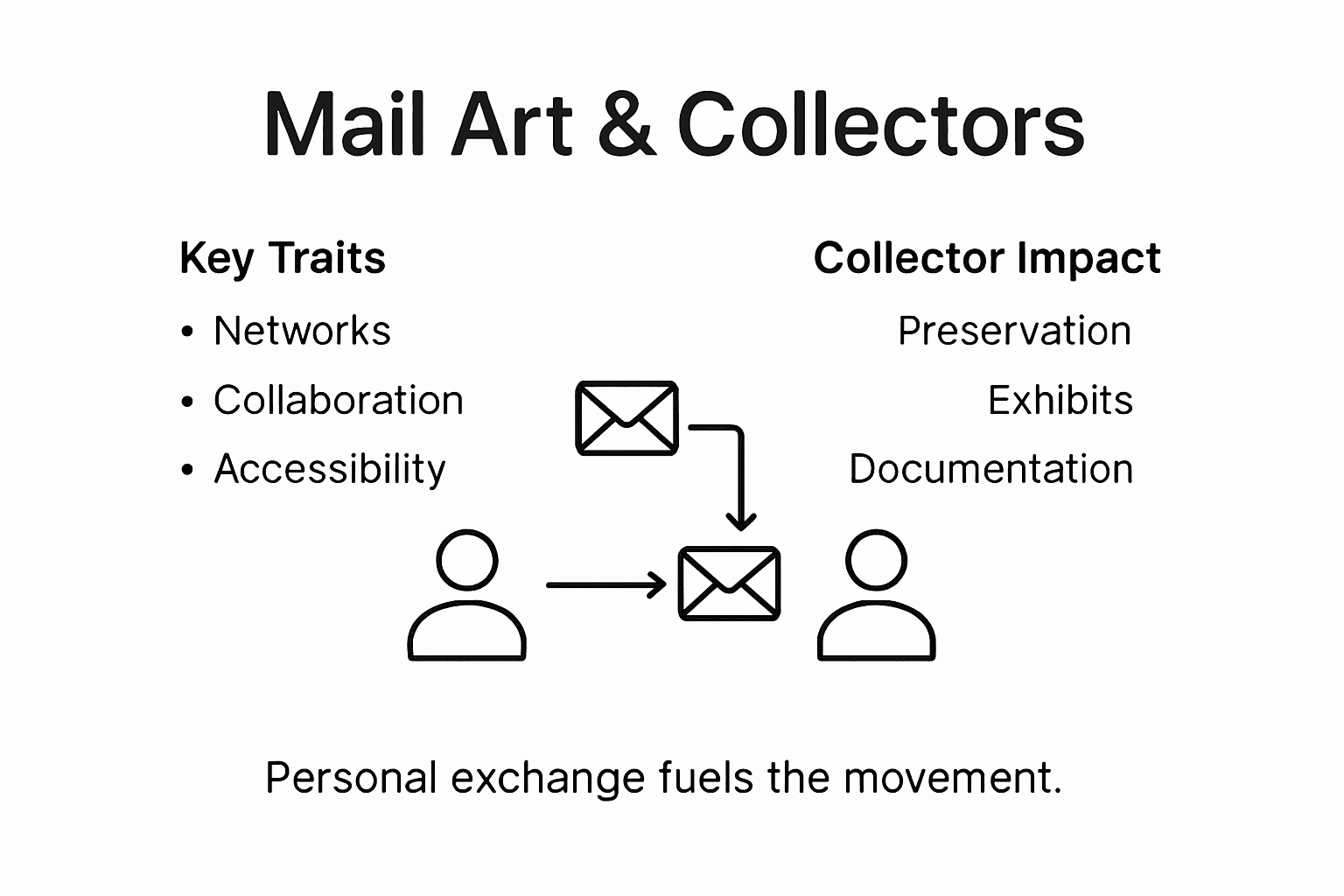
The accessibility of mail art networks is characterized by minimal participation barriers, allowing artists to engage through various mechanisms like mailing lists, thematic calls for submissions, and collaborative ‘assemblings’. These networks circulate creative challenges, provocative themes, and invitation-based projects that encourage artists to respond using postal mediums. The collaborative nature means each artwork potentially becomes part of a larger, interconnected artistic dialogue, with participants actively contributing to and transforming the ongoing creative conversation.
Mail art networks distinguish themselves through their decentralized structure, which eliminates traditional gatekeeping mechanisms found in mainstream art institutions. Artists can participate without formal credentials, financial resources, or institutional affiliations. These networks typically operate on principles of reciprocity, mutual respect, and open communication, where each contribution is valued equally. Subgenres like artist-made stamps, collaborative postal projects, and international exchange initiatives further demonstrate the movement’s commitment to democratizing artistic creation and challenging established artistic hierarchies.
Pro tip: Create a dedicated mailbox or contact address specifically for your mail art exchanges to streamline your artistic correspondence and build a systematic archive of your creative postal interactions.
Collectors’ Roles, Legal and Postal Realities
Collectors play a pivotal role in preserving mail art’s intricate historical legacy, serving as critical archivists and interpreters of this unique artistic movement. Unlike traditional art collectors, mail art enthusiasts function more as cultural historians, carefully documenting and maintaining an alternative artistic narrative that exists outside mainstream institutional frameworks. Their collections represent living archives that capture the dynamic, collaborative spirit of postal art, preserving works that might otherwise be lost to time and conventional archival practices.
The postal system itself becomes an integral component of mail art’s legal and aesthetic landscape, with postal regulations, markings, and transportation processes directly influencing artistic creation. Collectors must navigate complex legal terrains where traditional copyright concepts are deliberately challenged. Mail art operates in a unique legal grey area, rejecting commercial art market structures while simultaneously creating value through its networked, participatory nature. Postal marks, cancellation stamps, and routing information are not merely administrative artifacts but are considered essential aesthetic elements that contribute to each artwork’s narrative and meaning.
Collectors contribute to the movement’s sustainability by documenting, exhibiting, and sharing mail art pieces through specialized archives, digital repositories, and curated exhibitions. Their work ensures that these ephemeral artistic exchanges are preserved for future generations, providing critical insights into the social, political, and cultural contexts that shaped each piece. By maintaining comprehensive collections, these collectors transform individual postal interactions into a broader, interconnected artistic dialogue that transcends geographical and temporal boundaries.
Pro tip: Develop a systematic cataloging method for your mail art collection, including details about sender, date, postal route, and unique aesthetic characteristics to create a comprehensive archival record.
Common Myths and FAQs About Mail Art
Mail art challenges traditional art world assumptions by operating through unique principles that differ dramatically from conventional artistic practices. Many people mistakenly believe mail art is unstructured or random, when in fact it follows clear, intentional guidelines that prioritize democratic participation and creative expression. The movement fundamentally rejects commercial validation, instead establishing its own intricate networks of artistic exchange and mutual recognition.
Frequently asked questions about mail art often revolve around its legitimacy, commercial potential, and artistic significance. Contrary to popular belief, mail art is not about creating marketable objects but about fostering global connections and challenging established art world hierarchies. It operates on core principles such as universal acceptance of submitted works, rejection of jury systems, and an emphasis on collaborative creativity. Artists participating in mail art networks understand that the value lies in the process of exchange and communication, not in potential financial gains.
Critical misconceptions about mail art include the notion that it lacks serious artistic merit or is merely a hobbyist pursuit. In reality, mail art has been a powerful form of cultural and political expression, particularly in regions experiencing censorship or political repression. The movement’s decentralized nature allows artists to communicate across borders, share perspectives, and create art that transcends traditional institutional boundaries. Each piece becomes a statement about artistic freedom, personal connection, and the transformative power of creative communication.
Pro tip: Start exploring mail art by joining online forums and international mail art networks to understand the movement’s nuanced ethos and connect with experienced practitioners.
Unlock the World of Unique Art Collecting Inspired by Mail Art
Collectors face the challenge of preserving authentic, meaningful artistic exchanges like Mail Art that emphasize collaboration, personal connection, and creative freedom. This article highlights how Mail Art’s emphasis on global networks and artistic accessibility inspires collectors to seek rare, limited-edition pieces that tell a story beyond traditional galleries. At The Mansion Press you can explore exclusive artbooks, collector’s editions, and original artworks that celebrate this spirit of artistic dialogue and discovery.
Discover new ways to expand your collection with curated works from independent artists and comic creators worldwide. Benefit from our easy browsing, detailed product listings, and pre-order options that give you direct access to unique creations not found in typical retail stores. Start your journey toward building a creative archive today by visiting The Mansion Press and experience how art meets collectors in an inspiring, accessible space.
Frequently Asked Questions
What is mail art?
Mail art is an artistic movement that transforms postal communication into a creative medium. It began in the 1960s and involves artists using postcards, collages, rubber stamps, and various visual techniques to create unique artworks that challenge traditional artistic boundaries.
How does mail art impact collectors?
Collectors play a crucial role in preserving mail art by documenting and maintaining an alternative artistic narrative. They act as cultural historians, ensuring that ephemeral mail art pieces are archived and shared, contributing to a broader understanding of this unique movement.
What are some key characteristics of mail art?
Mail art is characterized by its interdisciplinary nature, emphasis on personal connection, and interactive elements. Artists often use handmade stamps, recycled materials, and personal narratives, and the artwork is completed only after it is mailed, making the postal journey part of the artistic experience.
How do mail art networks facilitate collaboration among artists?
Mail art networks operate as decentralized platforms that welcome participation from artists of all backgrounds. These networks encourage creative exchange through collaborative projects, thematic calls for submissions, and open communication, allowing artists to connect and transform their works collectively.