

How to Price Original Artwork: 3 Steps Boosting Sales 40%
Pricing original artwork feels like guesswork for most independent artists. Many undervalue their work by ignoring material costs, labor hours, and market data, leaving thousands of dollars on the table. This guide delivers three proven steps using size, time, and market benchmarks to price artwork confidently and boost sales by up to 40%.
Table of Contents
- Prerequisites: What You Need Before Starting
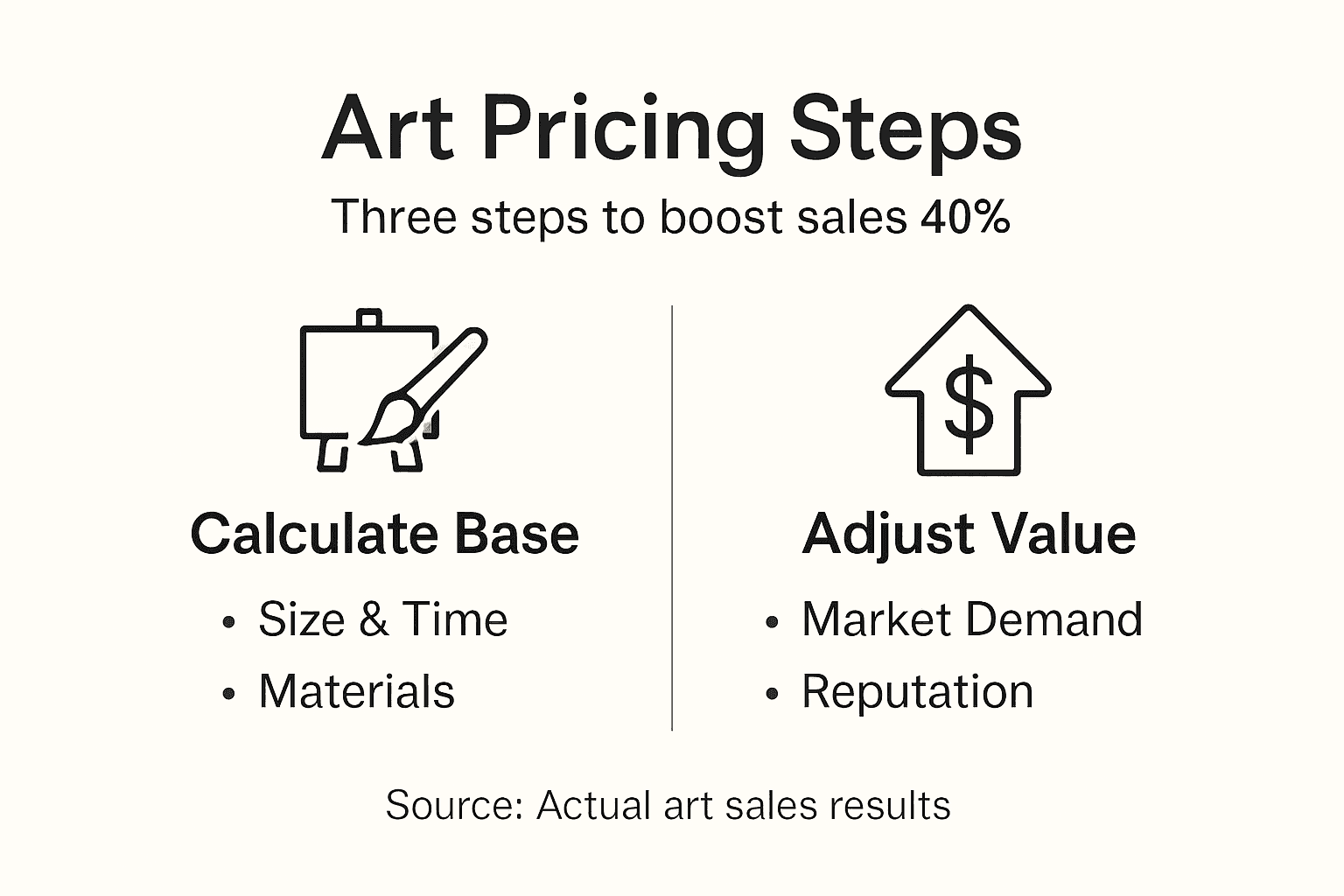
- Step 1: Calculate Base Price Using Size, Time, And Materials
- Step 2: Adjust Price Based On Market Demand And Artist Reputation
- Step 3: Benchmark Against Comparable Sales And Market Data
- Common Mistakes And How To Avoid Them
- Alternative Pricing Approaches And Tradeoffs
- Expected Outcomes And Realistic Sales Timelines
- Explore Expert Resources For Art Collectors And Creators
- How To Price Original Artwork: FAQ
Key Takeaways
| Point | Details |
|---|---|
| Accurate preparation matters | Gather precise measurements, track material costs, and research comparable sales before pricing. |
| Base price uses a formula | Multiply artwork size by cost per square inch, add labor hours times hourly rate, and include materials. |
| Market factors adjust value | Factor in artist reputation, exhibition history, and current collector demand for realistic markups. |
| Benchmarking validates pricing | Compare against 3 to 5 recent sales of similar works to ensure competitive, credible pricing. |
| Avoid common mistakes | Never ignore costs, skip market research, or set arbitrary prices without transparent rationale. |
Prerequisites: What You Need Before Starting
Before calculating any price, gather the right tools and data. Accurate measurement tools like metal rulers or digital calipers ensure you record exact artwork dimensions. Track every hour spent creating the piece and assign yourself a realistic hourly labor rate based on your skill level and local market standards.
Keep detailed records of material costs. Save receipts for canvas, paint, brushes, and framing supplies. Failure to calculate material costs leads to at least 25% of independent artists undervaluing their artwork and hurting profit margins, so tracking material costs effectively becomes essential. Access to comparable sales data from regional galleries, online platforms, or auction results provides market context.
Understand your current position in the market. Are you emerging with limited exhibition history, or do you have a growing social media following and gallery representation? Honest self assessment prevents overpricing or undervaluing your work. Finally, compile all this information into a simple spreadsheet or notebook for easy reference during pricing.
Required preparation checklist:
- Measurement tools for accurate dimensions
- Time tracking logs with assigned hourly rates
- Complete material cost receipts and estimates
- Market position assessment and reputation inventory
- Comparable sales database from galleries and online sources
Step 1: Calculate Base Price Using Size, Time, and Materials
Start with an objective formula that removes guesswork. Calculate your artwork’s total square inches by multiplying height times width. Multiply this number by your chosen cost per square inch, typically ranging from $1 to $5 for emerging artists and $10 to $50 for established artists depending on medium and market.
Add your labor investment next. Multiply total hours worked by your hourly rate. An emerging artist might use $25 per hour, while mid career artists often charge $50 to $100 per hour based on expertise and demand. Be honest about time spent, including planning, execution, and finishing touches.
Include explicit material costs as a separate line item. Add up every supply purchase directly tied to creating this specific piece. A transparent breakdown builds buyer confidence and justifies your asking price. For example, a 24x36 inch painting using $150 in materials with 20 hours at $40 per hour and $3 per square inch yields: (24x36x3) + (20x40) + 150 = $3,742 base price.
Document your formula clearly in your pricing worksheet. When potential buyers ask about pricing rationale, you can explain exactly how size, labor, and materials contribute to the final number. This transparency establishes professionalism and credibility, making collectors more comfortable with their investment.
Follow these calculation steps:
- Measure artwork dimensions precisely and calculate total square inches
- Multiply square inches by your established cost per square inch rate
- Calculate labor cost by multiplying hours worked times your hourly rate
- Sum all material costs from receipts and supply purchases
- Add all three components together for your base price foundation
Pro tip: Calculate base price formula consistency across your portfolio creates pricing credibility. Use the same cost per square inch and hourly rate for similar works to avoid confusing collectors.
Step 2: Adjust Price Based on Market Demand and Artist Reputation
Your base price represents production costs, but market value includes intangible factors. Evaluate your exhibition history, awards, press mentions, and social media following to gauge reputation strength. Artists with solo shows, museum collections, or significant followings command premium markups of 25% to 100% above base price.
Provenance adds value instantly. If the piece has unique historical significance, appeared in publications, or connects to a notable series, apply additional markup. Limited editions or one of a kind works with documented creation stories justify higher prices than standard portfolio pieces.
Create a reputation scale for yourself. Emerging artists with under 1,000 followers and no exhibitions might add 10% to 20% markup. Mid career artists with regional gallery representation and 5,000 to 20,000 followers can add 40% to 75%. Established artists with national recognition easily double or triple base prices.
Current market trends matter enormously. If collectors actively seek your style or medium right now, capitalize on demand with higher markups. Monitor auction results, gallery sales, and online platform activity to spot trends. Adjust pricing quarterly as your reputation grows and market conditions shift.
Reputation adjustment factors:
- Exhibition history at galleries, museums, or juried shows
- Social media following size and engagement rates
- Press coverage, interviews, and critical reviews
- Awards, grants, and professional recognition
- Collector testimonials and repeat buyer relationships
Pro tip: Adjust price for reputation and demand systematically by documenting reputation milestones. When you hit 10,000 followers or secure gallery representation, increase your markup percentage across all new works.
Step 3: Benchmark Against Comparable Sales and Market Data
Validate your proposed price against real market transactions. Identify three to five artworks similar to yours in size, medium, style, and artist reputation that sold recently. Search online galleries, auction databases, and regional art fairs for comparable sales data. Using comparable sales data from regional galleries or online platforms helps provide realistic pricing benchmarks for artists and collectors.
Create a comparison table listing each comparable artwork’s dimensions, medium, artist background, sale price, and platform. Calculate the price per square inch for each to spot patterns. If most comparables sold between $4 and $7 per square inch and your proposed price equals $12 per square inch, you likely priced too high for current market conditions.
Adjust your price proposal to fall within the realistic range established by comparables. Pricing slightly above the average is acceptable if you can justify superior technique, unique subject matter, or stronger provenance. Pricing far outside the range risks stalled sales and damaged credibility.
Account for geographic variations when benchmarking with comparable sales. Urban markets like New York or Los Angeles support higher prices than rural regions. Medium matters too: oil paintings typically command premiums over acrylics, and originals far exceed prints. Use comparable sales data specific to your location and medium.
| Comparable Artwork | Dimensions | Medium | Artist Level | Sale Price | Price per Sq In |
|---|---|---|---|---|---|
| Urban Landscape | 24x36 | Oil | Mid career | $4,200 | $4.86 |
| Abstract Composition | 30x40 | Acrylic | Emerging | $3,600 | $3.00 |
| Portrait Study | 20x30 | Oil | Mid career | $3,900 | $6.50 |
| Still Life | 24x36 | Oil | Emerging | $2,880 | $3.33 |
| Your Artwork | 24x36 | Oil | Emerging | $3,742 | $4.33 |
This table shows your proposed price falls comfortably within the comparable range, validating your pricing approach.
Common Mistakes and How to Avoid Them
Ignoring material costs remains the most damaging mistake. Artists who skip tracking supplies undervalue work by 25% or more, eroding profits and undermining market positioning. Always include every tube of paint, brush, and canvas in your calculations.
Setting prices without market data creates arbitrary numbers that confuse buyers. When pricing lacks supporting evidence from comparables or transparent formulas, collectors doubt value and hesitate to purchase. Research comparable sales religiously before finalizing any price.
Lack of transparent pricing rationale kills trust instantly. Buyers want to understand why your piece costs what it does. Artists who cannot explain their pricing process appear unprofessional or opportunistic. Document your formula and be ready to share it.
Overpricing without demand proof causes inventory to pile up unsold. If you lack exhibition history, press coverage, or social media proof of demand, aggressive markups backfire. Price realistically for your current market position and increase gradually as reputation grows.
Regularly refine pricing based on feedback and sales outcomes. If pieces sell within days of listing, you priced too low. If nothing sells after six months, you priced too high. Avoid common pricing mistakes by treating pricing as an iterative process requiring constant adjustment.
Key mistakes to avoid:
- Failing to track and include material costs in base price
- Setting prices based on gut feeling instead of market data
- Offering no transparent explanation for pricing decisions
- Overpricing before establishing market demand and reputation
- Never adjusting prices based on sales feedback and outcomes
Alternative Pricing Approaches and Tradeoffs
Auction pricing offers potential windfalls but carries significant risk. Works can sell above estimates if bidding competition erupts, but unsold lots damage reputation and confidence. Auctions suit established artists with proven demand more than emerging artists building markets.
Fixed gallery pricing provides stability and legitimacy. Galleries research markets thoroughly and set prices conservatively to ensure sales. You sacrifice higher margins to gallery commissions, typically 40% to 60%, but gain professional presentation and established collector networks.
Gallery collaboration leverages existing relationships for premium sales. Galleries introduce your work to serious collectors willing to pay top dollar for vetted artists. This approach works best for artists ready to commit inventory and accept gallery terms.
Dynamic pricing adapts to real time demand signals. Some artists raise prices as inventory depletes or social media buzz grows, then lower prices if sales stall. This requires active monitoring and willingness to experiment, making it better suited for experienced sellers than beginners.
Choose your approach based on career stage and goals. Emerging artists benefit from fixed, transparent pricing that builds trust. Established artists can experiment with auctions or dynamic models. Alternative pricing models each serve different needs.
| Pricing Model | Pros | Cons | Best For |
|---|---|---|---|
| Auction | Potential higher prices, excitement | Risk of no sale, volatility | Established artists with demand |
| Fixed Gallery | Price stability, credibility | High commission, less control | Artists seeking legitimacy |
| Gallery Collaboration | Access to serious collectors | Exclusive commitments required | Mid career artists ready to scale |
| Dynamic Pricing | Responsive to demand changes | Requires active management | Experienced sellers with analytics |
| Formula Based | Transparent, consistent | May not capture intangible value | Emerging artists building trust |
Expected Outcomes and Realistic Sales Timelines
Proper pricing takes time to convert into sales. The average time from pricing an original artwork properly to its successful sale is approximately 3 to 6 months, depending on the platform and artist network. Patience proves essential as collectors discover your work, research your background, and decide to invest.
Proper pricing can improve sales prices by 25% to 50% and reduce revenue losses compared to arbitrary pricing methods. Artists who implement formula based pricing with market validation report fewer unsold pieces and higher average sale prices within one year.
Transparent pricing builds collector trust measurably. Clear explanations of size, labor, materials, and reputation factors reduce purchase hesitation and cart abandonment by approximately 30%. Buyers feel confident they understand value and are not overpaying.
Pricing mistakes commonly cause 30% to 50% revenue losses through undervaluation or stalled inventory. Artists who ignore costs, skip market research, or overprice aggressively leave money on the table or warehouse unsold work indefinitely. Following structured pricing prevents these outcomes.
Consistency matters more than perfection. Stick with your pricing formula across multiple works and resist the temptation to discount heavily when sales slow. Collectors notice price stability and respect artists who maintain value integrity through sales timelines that span months.
Expected results summary:
- Average sales timeline of 3 to 6 months after proper pricing implementation
- Sale price improvements of 25% to 50% versus arbitrary pricing methods
- 30% reduction in cart abandonment through transparent pricing rationale
- Avoidance of 30% to 50% revenue losses from common pricing mistakes
- Gradual reputation growth leading to systematic markup increases over time
“The difference between guessing at prices and using a structured approach is the difference between hoping for sales and confidently expecting them. Transparent pricing transforms artists from hobbyists into professionals.”
Explore Expert Resources for Art Collectors and Creators
Now that you understand how to price original artwork systematically, deepen your knowledge with curated resources. Discover how Icons vs Artbooks guide explores different artistic formats and their market positioning. Learn advanced collecting strategies through our Artbook collection guide for building valuable portfolios.
Independent artists and collectors benefit from understanding both sides of the transaction. Our How to Buy Original Art Online resource complements pricing knowledge with buyer perspectives, helping you anticipate collector concerns and refine your sales approach for maximum success.
How to Price Original Artwork: FAQ
What tools help measure artwork dimensions accurately?
Use metal rulers, digital calipers, or laser measuring devices for precise dimensions. Fabric tape measures work for irregular shaped pieces, but metal tools prevent stretching errors that inflate square inch calculations.
How often should an artist update their pricing?
Review pricing quarterly or after significant reputation milestones like exhibitions, press coverage, or follower growth. Adjust cost per square inch and markup percentages systematically rather than changing prices randomly.
Can social media influence artwork price?
Yes, follower count and engagement rates directly impact reputation markups. Artists with 10,000 plus engaged followers command 40% to 75% premiums over those with minimal online presence because social proof validates demand.
What’s the risk of auction pricing for beginners?
Unsold auction lots damage emerging artist credibility and create doubt about artwork value. Auctions work best for established artists with proven collector demand and prior sales history supporting reserve prices.
How can material cost mistakes hurt sales?
Ignoring material costs forces you to underprice by 25% or more, training collectors to expect unrealistic bargains. When you later correct pricing to profitable levels, previous buyers feel cheated and your market positioning suffers long term damage.