

Comic Books vs Books: Artistic Value Explained
Standing before a shelf lined with both pristine comic books and classic novels, collectors are faced with more than just a choice of genre. The artistic value of comic books lies in their ability to blend sequential images with narrative text, creating a storytelling form that is fundamentally different from traditional literature. For those invested in the evolving recognition of comics as independent works of art, understanding these formats reveals why both mediums offer unique experiences and distinct artistic merit for North American collectors.
Table of Contents
- Defining Comic Books And Traditional Books
- Narrative Structures And Artistic Storytelling
- Visual Styles And Reading Experiences Compared
- Collecting, Rarity, And Market Value
- Cultural Perceptions And Literary Recognition
Key Takeaways
| Point | Details |
|---|---|
| Difference in Storytelling | Comic books utilize a combination of sequential art and text, engaging readers through visual and verbal processing, while traditional books rely solely on prose and the reader’s imagination. |
| Value Factors | The value of comic books is influenced by condition, rarity, and character significance, differing from traditional books where literary merit and author reputation are key. |
| Cultural Perception Shift | Comics have gained legitimacy as serious artistic works, with greater recognition in academia and popular culture, reflecting their complexity and narrative depth. |
| Collecting Insights | When collecting, focus on understanding the art style, panel layout, and condition of comic books, as these factors significantly affect their emotional impact and market value. |
Defining Comic Books And Traditional Books
At their core, comic books and traditional books represent two fundamentally different approaches to storytelling, though the distinction matters more than you might initially think as a collector. Traditional books rely almost entirely on the written word to convey narrative, character development, and world building. The reader’s imagination fills in the visual gaps based solely on textual descriptions. A sentence describing a character’s weathered face or a crowded marketplace exists only in the reader’s mind, shaped by their personal interpretations and experiences.
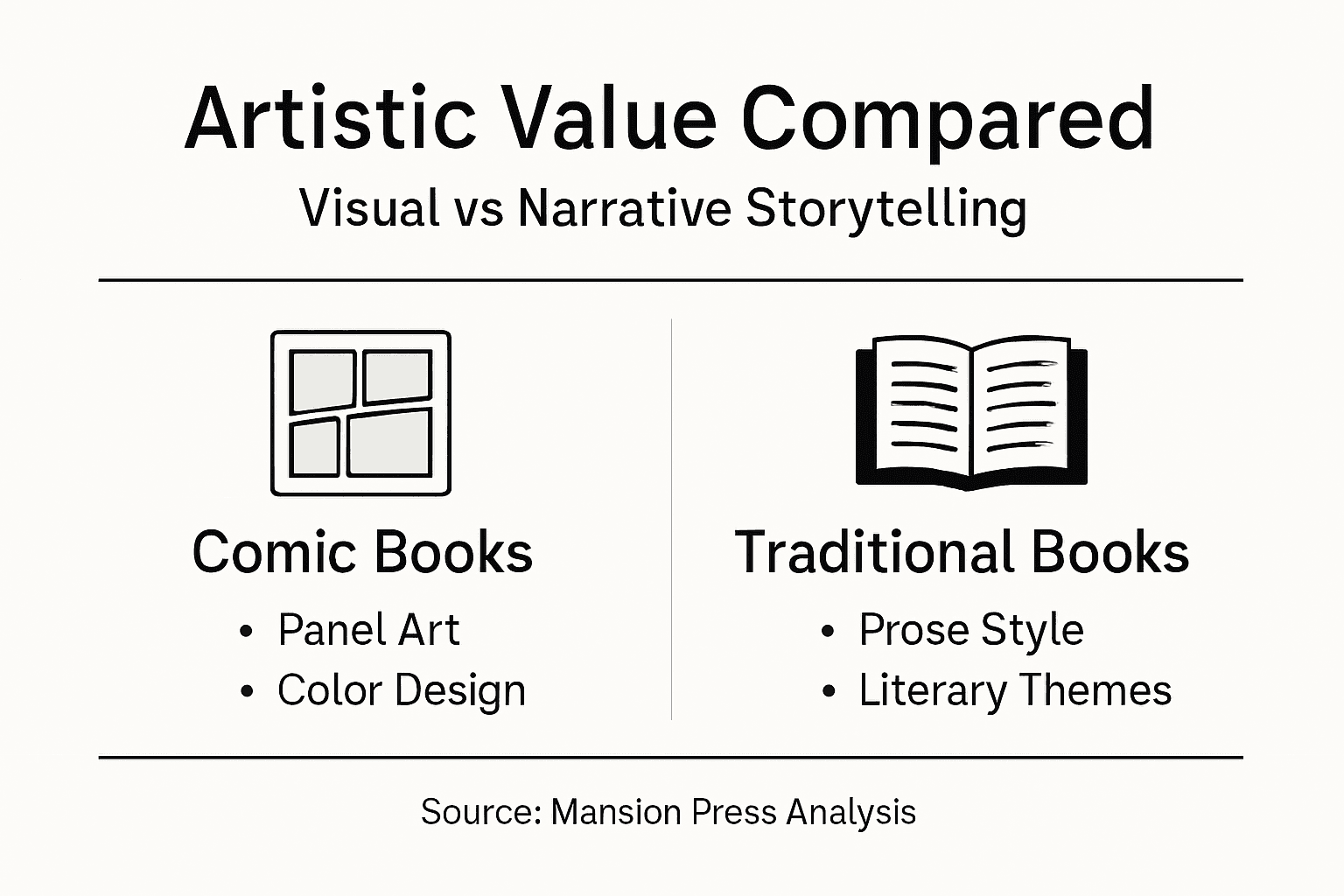
Comic books operate on an entirely different principle. They combine sequential pictures with narrative text to create a storytelling medium that bridges visual art and literature. Where a traditional book might use three paragraphs to describe a tense confrontation, a comic book accomplishes the same through panels, facial expressions, body language, and dialogue balloons working in concert. This isn’t just a stylistic choice. It fundamentally changes how information reaches the reader. You’re not imagining the scene based on words alone. You’re processing both visual and verbal data simultaneously, which creates a different cognitive and emotional experience.
The evolution of how we classify these formats matters for collectors like you. Comic books were once dismissed as mere entertainment for children, but the recognition of comic books as independent literary works reflects a major shift in cultural understanding over the past two decades. Comic books now occupy their own category in academic discussions of literature and art, rather than existing as some lesser cousin to traditional novels. This distinction became particularly clear when you look at how graphic novels differ from traditional comic book formats, each carrying distinct artistic and narrative intentions. The form, content, and visual style of comic books create unique opportunities for storytelling that traditional books simply cannot replicate. Meanwhile, traditional books excel at introspection, internal monologue, and narrative techniques that require sustained text without visual interference.
Understanding these core differences helps you appreciate what each medium offers as a collector. A stunning limited edition comic book isn’t just printed pages with words. You’re acquiring the artistic choices of the illustrator, the page layout decisions of the designer, and the visual sequencing that guides your eye through the narrative. These aren’t secondary elements to the story. They are the story. Traditional books, conversely, offer a different kind of artistic merit through typography, binding design, and the purity of language itself. Neither format is superior. They simply operate on different principles, each with distinct strengths and artistic merit that appeal to different aspects of how we experience storytelling.
Here’s a direct comparison of comic books and traditional books across major storytelling dimensions:
| Factor | Comic Books | Traditional Books |
|---|---|---|
| Storytelling Method | Sequential art with text | Pure prose and narration |
| Reader Engagement | Visual and verbal processing, active participation | Imagination-driven, mental visualization |
| Artistic Contribution | Illustrator and designer shape experience | Author’s language choices dominate |
| Value Focus | Artwork quality, condition, rarity | Edition, author reputation, binding |
Pro tip: When evaluating comic books for your collection, examine the artwork across multiple issues from the same illustrator to understand their stylistic choices and how they evolve over time. This depth of appreciation will significantly increase your understanding of the comic’s artistic value beyond the story itself.
Narrative Structures And Artistic Storytelling
The way a story gets told matters as much as the story itself. Comic books and traditional books achieve narrative through completely different mechanics, and understanding these differences reveals why collectors value each format differently. In traditional books, narrative flows in a linear fashion through pages of text. A writer describes action, emotion, and setting through prose. The reader absorbs information sequentially, building mental images from word descriptions alone. This approach allows for deep internal monologue, complex philosophical exploration, and narrative techniques like unreliable narrators or stream-of-consciousness passages that work exclusively through language.
Comic books construct narrative through what academics call spatial and temporal techniques that guide reader understanding across the page. Rather than describing a punch thrown in three sentences, a comic artist shows it through panel progression, motion lines, and facial expressions. The space between panels (called the gutter) becomes narrative space where readers actively participate in the storytelling. Comics integrate images with text to create hybrid narratives where neither element works independently. A dialogue balloon without the accompanying visual would lose its impact. A detailed illustration without text explanation becomes ambiguous. This collaborative relationship between word and image forces readers to engage actively in filling narrative gaps, creating a fundamentally different reading experience than passively consuming text.

The impact of serial publication shaped comic book narrative in ways that influenced their artistic structure permanently. Early comic books appeared in monthly installments, which forced writers and artists to develop cliffhangers, visual storytelling hooks, and pacing strategies designed to keep readers returning. This serial structure affected how panels were arranged, how much information appeared on each page, and how story arcs developed. Traditional novels, particularly those published in hardcover and paperback formats, didn’t face these same constraints. A novelist could develop a 600-page epic with elaborate character development and subplot weaving. A comic book artist working within monthly constraints had to accomplish similar storytelling depth through visual economy and sequential arrangement. This created distinct narrative conventions where comic books became expert at showing character emotion through facial expressions rather than explaining it through paragraphs of internal thought.
When you examine comic books from a collector’s perspective, you’re not just reading a story. You’re experiencing how the artist and writer collaborate through structure itself. The size of panels, the amount of white space, the angle of perspective shots, the sequencing of action across the page. All these choices constitute narrative technique in comics. Understanding narrative techniques in graphic novels helps you appreciate the deliberate choices that elevated comic books from simple entertainment to serious artistic medium. Traditional books offer different narrative rewards. The intimacy of a character’s internal struggle rendered through first-person perspective. The reliability (or unreliability) of a narrator shaped entirely through prose. The complex metaphors and symbolic language that create meaning beyond surface action. Both approaches create sophisticated storytelling. They simply use different artistic tools to achieve their narrative goals.
Pro tip: When collecting comics, pay attention to how different artists handle panel layouts and pacing across an entire issue, then compare their approach across multiple issues to identify their signature narrative style and how it contributes to the overall story’s emotional impact.
Visual Styles And Reading Experiences Compared
The moment you hold a beautifully printed comic book versus cracking open a traditional novel, your hands tell you something fundamentally different is happening. Visual styles in comics demand active participation from your eyes in ways that traditional books simply do not require. A comic page presents multiple entry points for visual information simultaneously. Panel borders guide your eye through a specific sequence. Color choices establish mood and atmosphere before you read a single word. Character expressions convey emotion instantly. Line weights and artistic technique become part of the narrative itself. Traditional books offer a different visual experience entirely. A page of printed text presents itself uniformly. The reader controls pacing by determining how quickly they move through sentences and paragraphs. Visual elements remain absent except for occasional chapter illustrations or book design flourishes.
The physical reading experience differs dramatically between formats, and this matters for collectors evaluating what you’re acquiring. Print comics offer more fluid reading experiences with faster comprehension compared to digital alternatives, while the tactile aspects of holding physical pages enhance engagement in specific ways. When you’re reading a comic book, you’re managing panel-to-panel transitions, deciding where your eye goes next, and processing visual information at variable speeds based on artwork density. A single panel packed with detailed illustration requires different viewing time than a splash page with minimal visual information. Traditional book readers encounter no such variables. Text flows uniformly across pages. Font size remains consistent. Reading speed depends on reader preference rather than visual composition choices made by the artist.
Comics integrate visual styles such as panel layout, color, and artwork to affect pacing and create distinct reading dynamics compared to predominantly text-based narratives. Consider how a colorist influences your experience through palette choices. Warm colors create urgency and intensity. Cool colors establish calm or melancholy. Grayscale artwork carries different emotional weight than vibrant color palettes. None of these visual decisions exist in traditional books. Instead, traditional literature creates mood through descriptive language. A novelist might spend a paragraph establishing the cold, institutional feeling of a hospital room. A comic artist conveys identical atmosphere through color temperature, shadow placement, and linework style. Both approaches work. They activate different parts of reader consciousness. Comics engage visual processing centers more directly. Traditional books activate imagination through language interpretation.
When examining comics for your collection, understanding how identifying different comic art styles contributes to reading experience helps you appreciate what you own on deeper levels. A comic from the 1970s with thick inking and limited color printing creates a fundamentally different reading experience than a contemporary graphic novel with digital illustration and full-spectrum color work. The visual style is not decoration applied over the story. It shapes how readers absorb narrative information moment by moment. Some collectors prize the raw energy of sketchy, minimal linework styles. Others favor meticulously detailed realistic artwork. Traditional book collectors evaluate typography, paper quality, and binding design but encounter no equivalent to the visual storytelling choices that define comics. Both mediums offer rich reading experiences. Comic books simply achieve their effects through visual means that create active, engaged reading where eyes and mind collaborate. Traditional books achieve their effects through language that allows imagination to construct its own visuals.
Pro tip: When adding comics to your collection, examine several pages at full size to understand how the artist’s visual style affects pacing and emotional impact, then note whether you prefer their approach across multiple works before committing to building a comprehensive collection.
Collecting, Rarity, And Market Value
Collecting comic books has transformed dramatically over the past decade. What started as a passion for stories and art now generates serious investment potential for collectors willing to understand market dynamics. The driving forces behind comic book value operate differently than traditional book collecting. A rare first edition of a classic novel holds value primarily through literary significance and scarcity. A rare comic book’s value depends on multiple interconnected factors including condition, cultural impact, character significance, and market demand. Over the past ten years, comic book collecting has evolved into a significant market driven by nostalgia, rarity, and graded certification. The introduction of professional grading services revolutionized how collectors evaluate and trade. A comic book graded 9.8 by a recognized certification service commands vastly different prices than an ungraded copy of the same issue, even if visually identical to the untrained eye. This standardization created transparency in the market and fueled record breaking sales that attracted serious investors alongside casual fans.
Understanding what makes comics valuable requires examining multiple components working together. Limited print runs, key character appearances, and condition grading heavily influence market value, creating a complex evaluation matrix that differs significantly from traditional book collecting. A comic’s rarity depends on age, original print run size, survival rate, and cultural staying power. The first appearance of a major character carries exponential value compared to later appearances. A 1962 issue introducing a character who later became culturally dominant might appreciate 10000 percent over decades. Meanwhile, a 1995 issue with identical artwork and storytelling quality might appreciate 5 percent if that character never achieved mainstream recognition. Traditional books rarely experience such dramatic value differentials based on character introductions. Instead, book value stabilizes around author reputation, literary significance, and edition rarity. A first edition Shakespeare folio holds value because Shakespeare defined literature. A comic book’s value fluctuates based on whether the characters introduced later became billion dollar film franchises.
Condition represents the most immediately measurable value component for collectors. What makes comic books rare and valuable includes age, condition, rarity, and cultural significance, with professionally graded specimens commanding premium prices. A comic with creased pages, faded colors, or worn binding loses substantial value even if story content remains intact. Professional grading services examine paper quality, color saturation, binding integrity, and structural damage to assign numerical scores on standardized scales. This contrasts sharply with traditional book collecting where some wear actually adds character and authenticity. A leather bound first edition with visible aging sometimes appeals to collectors specifically because it shows historical use. Comic book collectors, however, prioritize pristine condition because the visual artwork degrades with time and handling. A water stained comic becomes less readable as a visual narrative.
When evaluating your collection’s investment potential, recognize that rare comics increase in value through art, demand, and legacy factors, but this appreciation requires strategic decision making. Building value requires focus rather than accumulation. Collecting every issue from a popular series yields different returns than selectively acquiring key first appearances and limited editions from creators who later achieved critical recognition. Some collectors focus on golden age comics from the 1940s when print runs were tiny and survival rates remain extremely low. Others target silver age issues from the 1960s when print quantities increased but before modern collecting practices became standard. Still others pursue contemporary limited editions from independent publishers knowing future rarity depends on how popularity develops. Traditional book collectors typically seek out-of-print titles or signed first editions. Comic collectors hunt for issues where original print runs were deliberately limited or accidentally limited through market conditions.
To help collectors understand market differences, here’s a summary of what most influences value for each format:
| Value Factor | Comic Books | Traditional Books |
|---|---|---|
| Rarity Drivers | Print run, survival rate, key issues | First editions, signed copies, age |
| Condition Impact | Professional grading, visual integrity | Some aging may add beauty or authenticity |
| Cultural Impact | Character legacy, pop culture | Author’s historical significance |
| Investment Trends | Graded sales, pop culture spikes | Literary reputation, steady appreciation |
Pro tip: Before investing significantly in comics, spend time studying recent sold prices on certified books in your target category, then purchase only highest quality copies within your budget since condition differences create exponential value gaps that compound over decades.
Cultural Perceptions And Literary Recognition
Twenty years ago, admitting you collected comic books carried social stigma. Serious readers didn’t acknowledge comics as legitimate literature. Parents discouraged children from reading comics, viewing them as frivolous entertainment that prevented engagement with real books. This cultural dismissal ran deep, rooted in outdated assumptions about what qualified as serious art and literature. Today that perception has shifted dramatically. Comic books have risen as a subject of serious academic inquiry within literary and cultural studies, gaining recognition for their narrative and artistic complexity. Universities now offer courses analyzing comics through the same critical frameworks applied to Shakespeare and Dante. Academic publishers dedicate entire handbooks to comic book studies. Major literary journals publish peer reviewed articles examining comic book storytelling techniques. This institutional recognition signals a fundamental reassessment of what constitutes legitimate narrative art.
The shift in recognition happened gradually but accelerated significantly over the past decade. Comic books and graphic novels earned credibility through demonstrated artistic sophistication that critics could no longer dismiss. Creators like Art Spiegelman, whose graphic novel Maus examined the Holocaust through sequential art, proved that comics could address complex historical and emotional subject matter with depth matching traditional literature. Watchmen demonstrated that superhero comics could explore moral ambiguity and philosophical questions typically reserved for serious fiction. These landmark works forced cultural gatekeepers to acknowledge that the medium itself carried no inherent limitation on artistic merit. A story about grief, loss, or political resistance works equally well in words or in sequential images. The medium is neutral. What matters is the creative intention and execution.
Graphic novels and comics are increasingly recognized in education for enhancing literacy and engagement, reflecting broadened acceptance of comics as legitimate literary works. Educational institutions discovered what readers instinctively knew: comics engage visual learners differently than text alone. Students who struggled with traditional reading sometimes found graphic novels accessible entry points into complex narratives. Teachers began assigning comics not as supplements to real reading but as primary texts deserving serious analytical discussion. This educational shift reinforced cultural perception changes. If schools taught comics alongside canonical literature, they must hold equivalent value. Parents stopped viewing comics as frivolous. Young readers no longer felt embarrassed selecting graphic novels from library shelves. Comics became culturally legitimate without losing their popular appeal.
For collectors, this recognition matters profoundly. You’re no longer acquiring dismissed entertainment artifacts. You’re building collections of increasingly recognized artistic works. Museums now display original comic artwork alongside paintings and sculptures. Auction houses conduct serious comic book sales generating headlines when rare issues reach six figure prices. Art galleries exhibit comic pages as fine art installations. This institutional validation transforms how collectors understand their collections. A 1960s Spider Man issue isn’t just nostalgia. It’s a historical document of American popular culture during a transformative period. The artwork represents specific artistic styles and techniques from that era. The stories reflect cultural anxieties and values of that moment. Your collection becomes a curated archive of how American visual storytelling evolved across decades. This perspective shift from frivolous hobby to serious collecting mirrors broader cultural recognition. Comics occupy the same cultural space as literature, film, and visual art because they synthesize all three forms into something distinctly its own. That’s not frivolous. That’s sophisticated artistic expression deserving collection, study, and appreciation.
Pro tip: When discussing your collection with others, frame comics as narrative and visual art rather than superheroes or entertainment, which recontextualizes how people perceive the medium’s complexity and artistic legitimacy.
Discover The Unique Artistic Value Of Comics And Books At The Mansion Press
The article highlights the intricate differences between comic books and traditional books focusing on their distinct storytelling methods, visual styles, and cultural recognition. If you find yourself captivated by the narrative power of sequential art or fascinated by the artistic collaboration behind every panel and page, The Mansion Press offers a curated selection that brings these remarkable qualities to life. Whether you seek limited edition comics showcasing unique artistic styles or artbooks that celebrate the mastery of visual storytelling, you deserve to own pieces that reflect your passion for sophisticated artistic expression and thoughtful narrative structures.
Elevate your collection today by exploring our carefully chosen artbooks and comics. Every item connects you directly with independent artists and creators who share your enthusiasm for collecting storytelling mediums that blend visual art with literary depth. Do not wait to claim exclusive editions that capture the evolution of comics as serious art and cultural heritage. Visit The Mansion Press now and experience firsthand how each product transforms your appreciation of comics and books alike.
Frequently Asked Questions
What are the main differences between comic books and traditional books?
Comic books combine sequential art and text for storytelling, while traditional books primarily rely on prose. This creates different reading experiences, with comic books engaging both visual and verbal processing, and traditional books focusing on imagination-driven narrative.
How does the artistic value of comic books compare to traditional books?
Comic books possess unique artistic contributions through illustrations, page layouts, and visual sequencing, which are integral to storytelling. Traditional books, on the other hand, emphasize language, typographic design, and narrative depth in text, making each medium valuable in its own right.
Why have comics gained more artistic recognition in recent years?
Comics and graphic novels have been recognized for their narrative complexity and artistic merit, leading to academic studies and courses. Landmark works have showcased their ability to handle serious themes, transitioning from perceived children’s entertainment to respected literature.
How do collectors evaluate the value of comic books versus traditional books?
Comic book value is often determined by rarity, condition, and cultural impact, while traditional book value is influenced by author reputation, first editions, and literary significance. The grading and certification of comic books has introduced a structured valuation system that differs from traditional books.
Recommended
- Understanding Graphic Novels versus Artbooks Explained – The Mansion Press
- Understanding the Difference Between Graphic Novel and Comic – The Mansion Press
- Why Collect Graphic Novels: Understanding Their Value and Appeal – The Mansion Press
- Why Rare Comics Increase in Value: Art, Demand, Legacy – The Mansion Press