
What Is Visual Poetry and Why It Matters
More than half of contemporary visual artists and independent poets feel their creative boundaries are held back by convention, yet the growing global interest in American visual poetry shows how bold experimentation can disrupt old norms. For creators seeking fresh inspiration, visual poetry opens up new space where language meets design, sparking collaboration in international communities. Discover how visual poetry challenges common assumptions and invites artists to rethink the possibilities of expression.
Table of Contents
- Defining Visual Poetry And Common Misconceptions
- Types Of Visual Poetry And Core Distinctions
- How Visual Poetry Combines Art And Language
- Contemporary Practices And Global Applications
- Common Pitfalls And Tips For Visual Poets
Key Takeaways
| Point | Details |
|---|---|
| Visual Poetry Transcends Traditional Boundaries | It merges text and visuals, requiring simultaneous reading and viewing for deeper understanding. |
| Common Misconceptions | Many view visual poetry as merely decorative, overlooking its intricate artistic intent and constructed meaningful elements. |
| Types of Visual Poetry | Various forms such as concrete and multimedia poetry challenge traditional reading; each offers distinct strategies for blending text and visual design. |
| Visual Poetry as a Global Medium | It serves as a powerful tool for social expression, addressing themes like cultural memory and political resistance through innovative multimedia techniques. |
Defining Visual Poetry and Common Misconceptions
Visual poetry represents a revolutionary artistic form that transcends traditional linguistic boundaries, merging text and visual design into a singular expressive medium. Unlike conventional poetry that relies solely on verbal language, visual poetry requires simultaneous reading and viewing for full comprehension, blending graphic art with poetic language in innovative ways.
At its core, visual poetry deliberately breaks standard text conventions by transforming words into visual compositions. Modern visual poetry typically uses disassembled language materials, including text, letters, symbols, and pictographs, creating multimedia expressions that challenge linear reading experiences. Artists intentionally manipulate typography, spacing, and graphic elements to generate meaning beyond traditional linguistic structures.
Common misconceptions about visual poetry often stem from limited understanding. Many people mistakenly view these works as merely decorative or nonsensical, failing to recognize the intricate artistic intent. In reality, visual poems are carefully constructed pieces where every visual element contributes to the overall semantic and emotional landscape. The spatial arrangement, color, font selection, and text placement are not random but deliberate artistic choices that communicate complex ideas and feelings.
Pro tip: Approach visual poetry with an open mind, understanding that meaning emerges through both visual perception and linguistic interpretation.
Types of Visual Poetry and Core Distinctions
Visual poetry encompasses diverse artistic approaches that transform linguistic expression into multidimensional experiences. Types of visual poetry include concrete poetry, pattern poetry, and modern multimedia forms that challenge traditional reading conventions, each representing unique strategies for blending text and visual design.
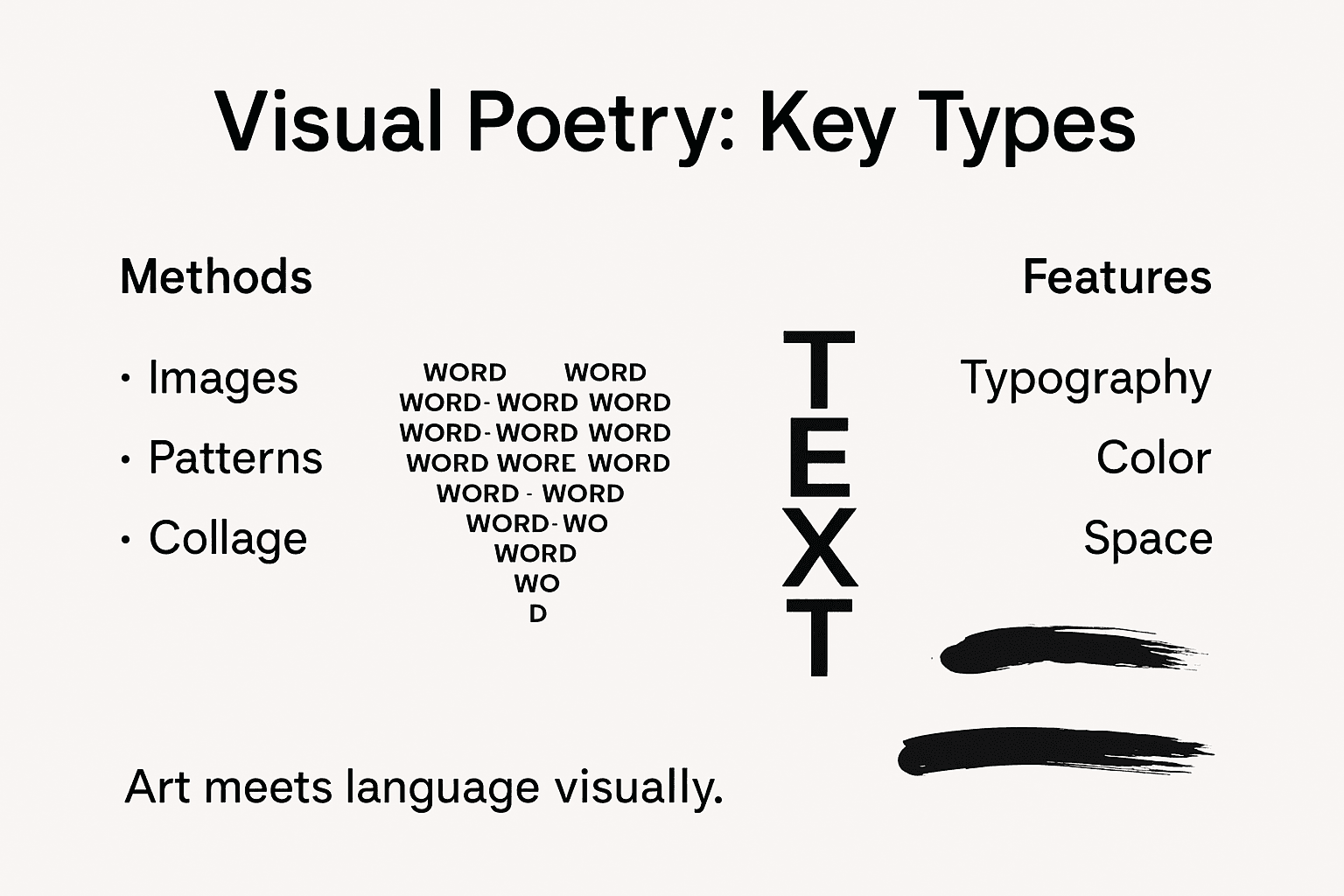
Concrete poetry stands out as a foundational form where words are meticulously arranged to create images directly reflecting the poem’s thematic content. Ancient Greek poets pioneered pattern poetry, strategically positioning text to generate visual meanings beyond traditional linear reading. Contemporary artists have expanded these techniques, developing sophisticated approaches that incorporate digital technologies, graphic design principles, and experimental typography.
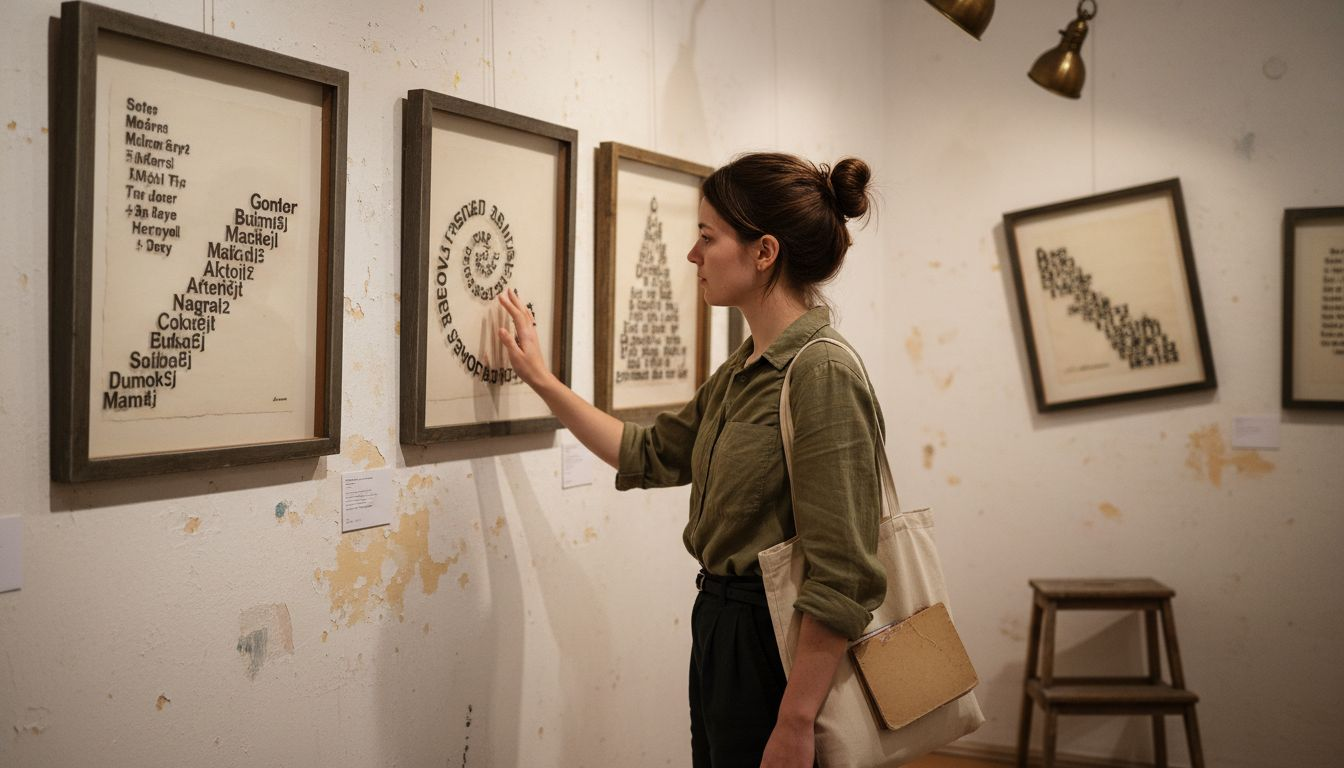
Modern visual poetry distinguishes itself through varying levels of linguistic and visual integration. Some forms remain highly readable, maintaining clear textual structures, while others drift into abstract visual art where text becomes a graphical element. These approaches range from carefully constructed typographic compositions to kinetic digital poems that incorporate movement, sound, and interactive elements. The core distinction lies in how artists manipulate text to generate meaning beyond conventional semantic interpretation.
Pro tip: Explore visual poetry with an experimental mindset, allowing yourself to experience the work through both visual perception and linguistic comprehension.
Here’s a summary of major visual poetry types and their characteristics:
| Poetry Type | Primary Method | Readability Level | Notable Artistic Features |
|---|---|---|---|
| Concrete Poetry | Arranges words into images | Generally high | Shapes mirror poem theme |
| Pattern Poetry | Structured text placement | Moderate | Uses visual motifs from antiquity |
| Multimedia Visual | Integrates digital elements | Varies (often low) | Movement, sound, interactivity |
| Experimental Forms | Abstract and conceptual use | Often challenging | Deconstructs text as visual material |
How Visual Poetry Combines Art and Language
Visual poetry represents a radical artistic approach that transcends traditional boundaries between linguistic and visual expression. Letters function within both linguistic and visual chains, enabling a simultaneous experience of reading and viewing, transforming text into a dynamic, multisensory medium.
The integration of art and language in visual poetry is not a superficial aesthetic exercise but a profound reimagining of communication. Typography, spatial arrangement, and visual design become fundamental components of meaning-making. Each letter, word, and graphic element is deliberately positioned to communicate beyond traditional semantic boundaries, creating a rich, layered experience where visual form and linguistic content are inseparable.
Artists working in this medium strategically manipulate visual elements to expand poetic expression. The spatial placement of words becomes integral to the poem’s meaning, challenging readers to engage with text through multiple sensory and conceptual levels. This approach transforms poetry from a purely auditory or textual experience into a complex visual artwork that demands active interpretation and engagement from its audience.
Pro tip: Approach visual poetry as a conversation between language and graphic design, where meaning emerges through both visual perception and linguistic exploration.
Contemporary Practices and Global Applications
Visual poetry has evolved into a powerful global medium for artistic and social expression, transcending traditional linguistic and cultural boundaries. Contemporary practitioners explore complex themes like ecological grief, cultural memory, and political resistance through innovative multimedia techniques, engaging audiences in profound dialogues about urgent global issues.
Digital platforms and international exhibitions have dramatically expanded the reach and impact of visual poetry. Artists now leverage technology to create dynamic, interactive works that challenge conventional communication methods. These multimedia presentations blend text, graphics, sound, and movement, transforming poetry from a static form into a living, breathing artistic experience that can simultaneously communicate across multiple sensory and intellectual planes.
Visual poetry has emerged as a critical tool for cultural resistance, particularly in regions experiencing historical oppression and social transformation. International exhibitions like the Kyiv Biennial demonstrate how visual poets use their art to document collective trauma, challenge political narratives, and create spaces for healing and solidarity. By reimagining language as a visual and emotional landscape, these artists communicate experiences that traditional linear text cannot capture, bridging cultural divides and amplifying marginalized voices.
Pro tip: Explore visual poetry as a global language of resistance, paying attention to works that emerge from contexts of cultural complexity and social change.
Common Pitfalls and Tips for Visual Poets
Visual poetry demands a nuanced approach that balances artistic innovation with intentional communication. Emerging poets often fall into predictable traps that undermine their creative vision, such as prioritizing visual complexity over meaningful content or becoming so abstract that the work loses interpretative potential. Understanding visual storytelling techniques can help poets navigate these challenges more effectively.
Successful visual poets develop a sophisticated understanding of how typography, spatial arrangement, and graphic design interact with linguistic meaning. Common mistakes include overcrowding compositions, using arbitrary visual elements that lack conceptual connection, and neglecting the fundamental relationship between form and content. Poets must learn to treat each letter, word, and graphic element as a deliberate artistic choice that contributes to the work’s overall semantic and emotional landscape.
Technical proficiency matters, but authentic visual poetry emerges from a deep understanding of language’s potential for transformation. Aspiring visual poets should experiment fearlessly, study diverse artistic traditions, and remain committed to pushing linguistic boundaries. This requires developing skills across multiple disciplines: graphic design, typography, linguistic theory, and conceptual art. The most compelling visual poems emerge when artists view language not as a fixed system, but as a dynamic, malleable material capable of profound reinvention.
The following table highlights key pitfalls and strategies for successful visual poetry:
| Common Pitfall | Why It’s Problematic | How to Overcome |
|---|---|---|
| Overcomplicating visuals | Confuses audience, dilutes meaning | Simplify to emphasize core message |
| Ignoring typographic choices | Misses expressive potential | Study and apply typography principles |
| Overuse of random graphics | Lacks conceptual unity | Make every element intentional |
| Neglecting spatial balance | Creates visual clutter | Use white space for clarity |
Pro tip: Cultivate a practice of visual experimentation, treating each poem as an opportunity to challenge your own assumptions about language and representation.
Experience the Bold Fusion of Art and Language Today
Visual poetry breaks the rules of traditional reading by blending words with powerful visuals to create a deeply emotional and intellectual experience. If you have been inspired by how visual poetry challenges the limits of language and explores new dimensions through typography and design you will find a unique opportunity to connect with this innovative art form at The Mansion Press. We understand the challenge of balancing complexity with clear meaning in visual storytelling and curate collections that celebrate artists who master this delicate interplay.
Discover exclusive artbooks comics and limited-edition works that bring visual poetry’s spirit to life in collectible form. Step beyond ordinary art and immerse yourself in pieces that provoke thought and stir emotion. Visit The Mansion Press website today and explore how you can own and support visionary creators transforming language into visual masterpieces. Elevate your collection now and experience the compelling dialogue between art and text firsthand.
Frequently Asked Questions
What is visual poetry?
Visual poetry is an innovative artistic form that combines text and visual design, allowing for simultaneous reading and viewing to create a multilayered expressive medium.
What are the main types of visual poetry?
The main types of visual poetry include concrete poetry, which arranges words into images; pattern poetry, which uses structured text placement; and multimedia visual poetry that integrates digital elements.
How does visual poetry differ from traditional poetry?
Unlike traditional poetry, which relies solely on verbal language, visual poetry blends graphic elements with poetic language to generate meaning beyond conventional linguistic structures.
Why is visual poetry important in contemporary art?
Visual poetry serves as a powerful medium for artistic and social expression, addressing complex themes such as ecological grief and cultural memory and enabling artists to communicate messages that transcend traditional language.
Recommended
- Understanding Visual Poetry in Graphic Novels – The Mansion Press
- What Is Visual Storytelling? Complete Guide for Artists – The Mansion Press
- Understanding Visual Narrative: The Art of Storytelling – The Mansion Press
- Overcoming the Challenge of Visual Storytelling in Art – The Mansion Press
- Master Visual Storytelling Techniques for Global Impact