

V for Vendetta: Cultural Legacy for Collectors
Serious art collectors know that finding an edition with true historical and artistic value is a challenge worth pursuing. The V for Vendetta graphic novel stands out not only for its innovative visual storytelling but also for its bold critique of power, setting a new standard for graphic literature. Fully exploring its dystopian vision, symbolic imagery, and intricate character development, this guide helps collectors identify editions that capture the graphic novel’s enduring influence and unique artistry.
Table of Contents
- Defining V for Vendetta Graphic Novel
- Publication History and Editions Worldwide
- Key Themes, Art Style, and Characters
- Collecting V for Vendetta: Editions and Value
- Cultural Impact and Artistic Influence
- Comparing Graphic Novel with Film Adaptation
Key Takeaways
| Point | Details |
|---|---|
| Cultural Significance | V for Vendetta is a landmark graphic novel that critiques totalitarianism and explores themes of individual resistance. |
| Iconic Imagery | The Guy Fawkes mask has become a global symbol of rebellion against institutional power since its introduction in the graphic novel. |
| Publication History | Originally serialized in the 1980s, V for Vendetta has evolved through multiple editions, making it a significant collectors’ item. |
| Adaptation Comparison | The film adaptation differs in tone and focus, emphasizing broader access while retaining the core philosophical themes of the original work. |
Defining V for Vendetta Graphic Novel
The V for Vendetta graphic novel represents a groundbreaking work in comic book storytelling, challenging traditional narrative conventions and exploring complex political themes through a visually compelling medium. Authored by Alan Moore and illustrated by David Lloyd, this seminal work transcends typical genre boundaries, offering readers a nuanced exploration of individual resistance against systemic oppression.
Published initially in black and white serialized format in the early 1980s, V for Vendetta emerged as a powerful critique of totalitarian governance, drawing inspiration from the sociopolitical tensions of Thatcherian Britain. Graphic novels demonstrating literary significance challenge traditional perceptions about comic book storytelling, presenting a narrative that is both intellectually rigorous and aesthetically innovative.
Key narrative elements that define the graphic novel include:
- A dystopian setting in a fascist-controlled Britain
- The mysterious protagonist “V”, a masked revolutionary
- Complex moral questions about resistance and individual agency
- Intricate visual storytelling that integrates text and imagery
- Exploration of anarchist philosophy and political resistance
The novel’s visual design is revolutionary, with Lloyd’s artwork creating a stark, atmospheric representation of a repressive society. Symbolic imagery plays a crucial role, with V’s Guy Fawkes mask becoming an enduring icon of rebellion against institutional power. Powerful narrative exploring human spirit emerges through the interplay of visual and textual storytelling, inviting readers to engage critically with themes of freedom, identity, and social transformation.
Pro tip: Collectors should seek original serialized editions and first printings, as these represent significant cultural artifacts that capture the graphic novel’s initial impact and artistic vision.
Publication History and Editions Worldwide
V for Vendetta represents a landmark publication with a complex international publishing history that spans multiple decades and formats. Multiple global editions emerged throughout its publishing journey, transforming the graphic novel into a truly international cultural phenomenon.
Originally published between 1982 and 1985 as a black and white serial in the British anthology Warrior, the graphic novel underwent a significant transformation when DC Comics completed its serialization in 1988–89 as a 10-issue color limited series. Worldwide publication details reveal remarkable distribution achievements, including selling over 500,000 copies in the United States by 2006.
Notable international editions include:
- British original serialized version in Warrior magazine
- DC Comics color limited series (1988-1989)
- Vertigo collected editions
- International translations by:
- Planeta DeAgostini Comics (Spain)
- Rizzoli (Italy)
- Panini Comics (multiple regions)
Key publication milestones showcase the graphic novel’s evolving publishing landscape:
- Initial black and white serialization (1982-1985)
- Complete color limited series (1988-1989)
- First collected editions (early 1990s)
- 30th Anniversary Deluxe Edition
- Absolute Edition collector’s hardcover
Collector’s editions have become particularly significant, with specialized printings capturing the graphic novel’s artistic and narrative complexity. These editions often feature enhanced artwork, additional commentary, and premium printing techniques that appeal to serious collectors and comic book enthusiasts.
Here’s a summary of pivotal V for Vendetta publication milestones and their significance:
| Milestone Edition | Year(s) | Notable Features | Collectibility Impact |
|---|---|---|---|
| Warrior Magazine Serialization | 1982-1985 | Original black & white format | High for first appearances |
| DC Comics Color Series | 1988-1989 | Complete 10-issue color run | Key for U.S. collectors |
| Vertigo Collected Editions | Early 1990s | Consolidated full story, new audience | Moderate, widely distributed |
| 30th Anniversary Deluxe Edition | 2015 | Enhanced artwork, supplemental content | Strong among contemporary buyers |
| Absolute Edition Hardcover | Various | Oversized, premium materials | High, appeals to serious collectors |
Pro tip: Serious collectors should authenticate international editions by verifying publication dates, print runs, and specific publisher imprints to ensure the edition’s true collectible value.
Key Themes, Art Style, and Characters
V for Vendetta explores a complex philosophical landscape where political ideology and personal transformation intersect dramatically. Graphic novel themes reveal profound sociopolitical commentary through its nuanced exploration of freedom, resistance, and individual agency against systemic oppression.
Thematic Elements of the graphic novel encompass multiple layers of social critique, including:
- Freedom versus institutional control
- Anarchism as a political philosophy
- The power of symbolic resistance
- Individual transformation
- Critique of fascist governance
Character development demonstrates psychological complexity through the intricate relationship between V and Evey. Their interactions explore profound questions about identity, mentorship, and revolutionary ethics. V represents a mysterious, masked revolutionary whose actions challenge established power structures, while Evey undergoes a transformative journey from vulnerability to empowerment.

The graphic novel’s art style is particularly noteworthy, combining dark, moody visual aesthetics with sequential storytelling that enhances its dystopian narrative. David Lloyd’s artwork employs shadowy, high-contrast imagery that captures the psychological tension of the story, using visual symbolism to reinforce the narrative’s deeper philosophical questions.
Key characters include:
- V - Masked revolutionary and protagonist
- Evey Hammond - Central character who transforms through V’s mentorship
- Adam Susan - Leader of the fascist Norsefire regime
- Valerie Page - Backstory character representing resistance against oppression
Pro tip: Serious collectors should focus on early editions that showcase the original artwork’s raw emotional intensity, as these editions often capture the graphic novel’s most authentic visual representation.
Collecting V for Vendetta: Editions and Value
Collecting V for Vendetta requires a nuanced understanding of market dynamics and historical significance. Detailed market pricing reveals complex valuation strategies that extend beyond simple monetary worth, encompassing cultural and artistic value.
The collectible landscape for V for Vendetta includes multiple valuable editions:
- Original 1980s Warrior magazine prints
- DC Comics limited series issues
- Hardcover collected editions
- Deluxe and Absolute versions
- Special retailer preview editions
Collector resources demonstrate significant price variations based on several critical factors:
- Publication year
- Print condition
- Edition rarity
- Specific issue number
- Preservation state
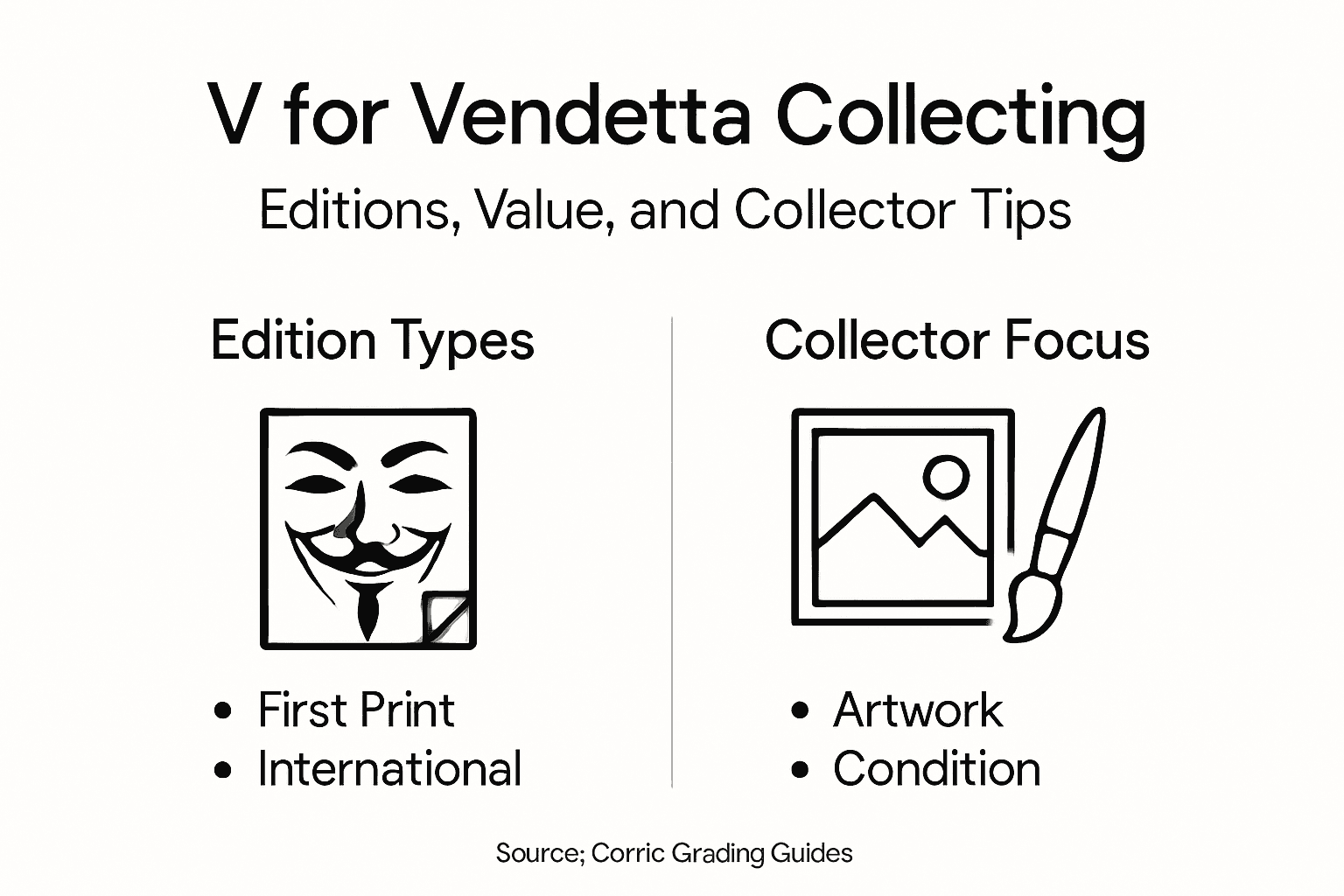
Price ranges for V for Vendetta editions are remarkably diverse. Common issues might sell for just a few dollars, while mint condition key issues can fetch over $50. The most sought-after versions include:
- First print issues
- Limited edition hardcovers
- Signed artist editions
- Complete original series sets
Collector Strategies involve careful evaluation of each edition’s unique characteristics. Serious collectors prioritize original prints, limited editions, and versions that maintain exceptional visual and structural integrity. Authentication and professional grading can significantly enhance an edition’s collectible value.
Pro tip: Always verify the authenticity and condition of V for Vendetta editions through professional comic grading services before making significant investments.
Cultural Impact and Artistic Influence
V for Vendetta transcends the traditional graphic novel format, emerging as a profound cultural touchstone that challenges sociopolitical narratives through innovative storytelling. Intertextual themes explore complex ideological conflicts that resonate far beyond its original publication context.
The graphic novel’s artistic and cultural significance is characterized by multiple transformative elements:
- Critique of totalitarian political systems
- Exploration of individual resistance
- Symbolic revolutionary imagery
- Philosophical challenges to institutional power
- Nuanced representation of social transformation
Symbolic Representations play a crucial role in V for Vendetta’s cultural narrative. The iconic Guy Fawkes mask, originally a specific historical reference, has been transformed into a global symbol of resistance against oppressive systems. This visual metaphor has transcended the graphic novel’s pages, becoming a recognizable emblem in real-world political protests and social movements.
Key areas of artistic and cultural influence include:
- Political discourse and activism
- Visual storytelling techniques
- Comic book narrative complexity
- Representation of philosophical resistance
- Intersection of art and political commentary
Artistic Innovation in V for Vendetta fundamentally challenged graphic novel conventions, demonstrating that comics could be sophisticated vehicles for complex social critique. The work’s visual and narrative strategies expanded understanding of sequential art’s potential for meaningful cultural commentary.
Pro tip: Serious art historians and collectors should document the graphic novel’s visual and thematic evolution to understand its broader cultural significance.
Comparing Graphic Novel with Film Adaptation
The adaptation of V for Vendetta represents a complex translation of artistic vision across different media, challenging traditional expectations of graphic novel-to-film conversions. Film adaptation transforms narrative context while maintaining the core philosophical essence of the original work.
Significant differences between the graphic novel and film adaptation include:
- Narrative tone and moral complexity
- Character development approaches
- Political and historical references
- Visual storytelling techniques
- Thematic emphasis and interpretation
Adaptation strategies reveal nuanced interpretative choices that fundamentally reshape the original narrative. The film strategically updates the story’s context, transforming the setting to address contemporary political anxieties while preserving the revolutionary spirit of the source material.
Key comparative elements highlight the adaptation’s unique approach:
- Humanization of V’s character
- Enhanced romantic subplot
- Simplified moral framework
- Updated political references
- Broader audience accessibility
Narrative Transformations demonstrate the challenges of translating complex graphic novel narratives into cinematic experiences. The film necessarily condenses philosophical nuances while expanding visual storytelling potential, creating a different but complementary interpretation of the original work.
The following table compares the graphic novel and film adaptation to highlight their unique attributes:
| Aspect | Graphic Novel | Film Adaptation |
|---|---|---|
| Narrative Complexity | Deep philosophical layers | Streamlined for broader audience |
| Visual Style | Stark, high-contrast, shadowy art | Cinematic, vivid set designs |
| Political Context | Thatcher-era Britain influence | Contemporary political updates |
| Character Focus | Ambiguous, morally complex | More humanized, romantic elements |
| Thematic Emphasis | Anarchism, individual agency | Resistance, empowerment themes |
Pro tip: Serious collectors should acquire both graphic novel and film adaptation materials to understand the full scope of the narrative’s artistic evolution.
Preserve the Legacy of V for Vendetta with Exclusive Collector’s Editions
The journey of V for Vendetta from a visionary graphic novel exploring anarchism and political resistance to a cultural icon presents a unique challenge for collectors seeking authenticity and depth. Whether you are passionate about the original black and white serialization or the deluxe editions that capture David Lloyd’s moody artwork and Alan Moore’s complex narratives, finding limited-edition prints that honor this legacy is essential. At the core is the desire to own a piece of cultural history that reflects the symbolic power of V’s rebellion and the graphic novel’s profound impact on art and activism.
Discover a curated selection of rare artbooks, collector’s editions, and exclusive comics at The Mansion Press. Dive deeper into the artistic evolution of V for Vendetta by exploring our collection crafted for discerning enthusiasts who value authenticity and artistic collaboration. Don’t miss your chance to enrich your collection with pieces that resonate with the novel’s sociopolitical themes and revolutionary spirit. Visit The Mansion Press online now and secure your connection to this iconic work before limited availability ends.
Frequently Asked Questions
What are the key themes explored in V for Vendetta?
The graphic novel addresses themes such as freedom versus institutional control, anarchism, the power of symbolic resistance, individual transformation, and a critique of fascist governance.
How does the art style of V for Vendetta contribute to its narrative?
David Lloyd’s artwork utilizes shadowy, high-contrast imagery, enhancing the psychological tension of the story and reinforcing the graphic novel’s deeper philosophical questions through visual symbolism.
What makes first print editions of V for Vendetta collectible?
First print editions are particularly valuable due to their historical significance as original serialized works, featuring raw artistic representation and providing a direct connection to the graphic novel’s initial cultural impact.
How does the film adaptation of V for Vendetta differ from the graphic novel?
The film adaptation streamlines the narrative for broader audience accessibility, humanizes V’s character, and updates political references, while still maintaining the core philosophical essence from the original graphic novel.